# Welcome to Plasma.Finance - DeFi & NFT Metaverse
Multi-chain DeFi protocol aggregator and Portfolio Management System

Plasma.Finance is a professional DeFi dashboard that aggregates the most popular DeFi protocols and blockchains in one dApp. Plasma.Finance creates an all-in-one solution that is useful for experienced users and novices alike. With Plasma.Finance, we aim to simplify and democratize the DeFi market and lower the barriers to entry.
Plasma.Finance portfolio management supports the next chains:
* Ethereum
* Polygon (Matic)
* Binance Smart Chain (BSC)
* xDai
* Fantom
* OKEX Chain (OEC)
* Huobi Chain (HECO)
* Avalanche
* Arbitrum
* Optimism
* Celo
* Moonriver
* Crypto.com Chain (Cronos)
* Boba Chain
* more...
Using Plasma.Finance users can easily manage their DeFi portfolio from a single intuitive interface. The dashboard is easily unlocked with Metamask or any other web 3.0 wallet.
Plasma.Finance offers a variety of advanced financial tools that allow you to remain in the driver's seat of your financial freedom and all without the need for a degree in cryptography. Our aim with creating our Dashboard was to give universal access to the very best DeFi tools with the goal of pushing crypto adoption to the masses.
A major element that we aim to make simple is Plasma.Finance to act as a bridge between the centralized and decentralized financial markets by providing a seamless way to connect fiat on- and off-ramps for users across the world. Users can request payments, deposit and withdraw digital assets all with a click of a button, it’s this swift simplicity that makes our Dashboard an essential part of your financial life.
Plasma.Finance also supports PlasmaSwap AMM protocol, HyperDEX protocol, Liquidity Pools, Lending and Borrowing protocols, Bridges and NFT. PPAY is a governance token of the platform that community is using to vote for protocol and roadmap updates.
# What is Plasma Finance dApp?
Plasma Finance is a real DeFi and NFT Metaverse! Do you ask what it means? We created a platform that hosts multiple tools to navigate in the world of decentralized finance: from investing in cryptocurrency to managing your portfolio.
**Plasma Finance ecosystem includes:**
1. HyperDEX trading platform that aggregates liquidity across various decentralized exchanges on multiple blockchains
2. Portfolio Management tool that helps users monitor all their crypto assets, NFT and DeFi activity via one dashboard
3. The Market platform that shows the full information about a wide range of tokens
4. Savings dashboard that helps to stake cryptocurrency tokens and keep track of the best APYs
5. SpacePort launchpad platform that helps blockchain teams to conduct IDOs and users to participate in token launches in a decentralized way
6. Bridge Aggregator that helps to move tokens between supported chains
**Plasma Finance has many great features:**
1. All our products are decentralized and use the data from on-chain sources, which helps us get the most accurate real-time information for you.
2. We have built an interoperable cross-chain solution working across 6 major networks: Ethereum, Binance Smart Chain, Avalanche, Polygon, Fantom, Celo. This means that you can enjoy the benefits and trade the tokens of all these blockchains with ease on Plasma. We will keep adding bridges to other networks in the future.
3. For users who have multiple cryptocurrency Web3 wallets, we offer a Wallet Management function that helps you connect and manage tokens from all wallets in one dashboard. Supports over 75 wallets including PlasmaPay Wallet, Metamask, Coinbase Wallet, Wallet Connect, Trust Wallet and Ledger.
4. The Fiat on-ramp feature connects Plasma Finance tools with the fiat world and helps our users buy and sell tokens for fiat on the platform directly via their credit cards or bank accounts using current market rates. Our fiat on-ramp function supports over 160 countries across the globe. Our partners PlasmaPay, Ramp and Simplex connect the platform to the following fiat providers and e-wallets: Visa, Mastercard, SEPA, SWIFT, MoonPay, ApplePay, GooglePay, XanPool and others.
5. All Plasma Finance platforms are interoperable – simply connect your wallet, monitor your assets, trade, and enjoy DeFi from the convenience of one dashboard.
6. And of course, Plasma products are accessible and easy to use for both novice and professional traders due to convenient UI & UX
We have already done a lot in disrupting DeFi, but we are always developing the Plasma Finance platform. One of the most revolutionary features is a Plasma Gas Station that brings the opportunity to use any ERC-20 token instead of ETH to pay for gas fees.
Plasma Finance is one the way to becoming the most convenient one-stop-shop solution to trade, engage in DeFi activities and monitor any crypto assets in your portfolio.
# Plasma Team Vision
What’s in the name? Plasma is an essential part of every object on the planet, everything that surrounds us contains plasma. Our project name is closely tied with our mission and vision of the future of Web3 and DeFi and our role in it!
At Plasma, we see the future in decentralizing the financial system and making it accessible for everyone without any dependence on geographical location, demographic factors, socio-economic status or technology knowledge. We believe that each person must enjoy finance that respects privacy, has no boundaries, no entry barriers and no hacking risks.
How we are planning to accomplish this task? By using the best of blockchain and technology worlds and creating truly global and user-friendly decentralized products for both crypto natives and crypto newbies.
Plasma Team went on the market in 2017 before the first DeFi boom. Gradually, we started noticing that while the industry is growing and new protocols are appearing on the market every day, users get frustrated. While ‘bringing DeFi to the masses’ is the ultimate goal of every project, the majority of protocols are still focused on tech and crypto native audiences, leaving average users puzzled with a clunky interface, heavy lingo and limited onboarding materials. Users want to trade, stake, monitor their assets and do other operations, but often they have to switch between different platforms to do that.
Enter Plasma.Finance – the ultimate DeFi solution to save your time, money, and effort in everything from trading to monitoring your portfolio.
# Plasma Team
Plasma Finance is founded by [Ilia Maksimenka](https://www.linkedin.com/in/maksimenka/), CEO, who was managing various projects in industries ranging from edtech to fintech and blockchain for the past decade.
The Plasma Finance team is fully decentralized and consists of 25 senior developers.
# DeFi Glossary
## Aave
[Aave](https://aave.com/) is an open-source and non-custodial lending protocol enabling the creation of money markets.
Users can earn interest on deposits and also borrow assets. Aave provides depositors a Liquidity Token that represents an equivalent derivative deposit in an identical asset.
For example, a user can deposit DAI and receive aDAI, which is a type of USD-based crypto derivative that essentially represents the value of the underlying DAI asset plus the interest gains from allowing the borrowing of one's DAI. That aDAI, could then also be used to implement further strategies to potentially amplify their gains even further.
## Alpha Code
Early-stage prototype computer code, programs, and algorithms meant to solve a problem, and/or provide new digital goods or services. Alpha software comes with the expectation that the code is at an early prototype stage and is meant for an early testing phase meant for very limited testing.
Alpha code or software may be missing all or parts of expected software functionality. Planned features and the security of the software may also be very limited or even non-existent in many aspects.
## Audit
An audit is either an internal or independent comprehensive review of a concept, system, process, company, or product. A comprehensive audit includes a thoughtful and in-depth look at the structure, strengths, weaknesses, and vulnerabilities of the thing or process being audited.
Audits may be either informal or formal audits and are meant to be a tool to find and analyze weaknesses, so that issues and problems discovered during an audit may be remediated, mitigated, or corrected.
## APY
Annual Percentage Yield, a time-based measurement of the Return On Investment (ROI) on an asset. For example, $100 invested at 2% APY would yield $102 after one year, if there is no compounding of any interest earned on that $100 through the year. Assuming a static APY rate, the Monthly ROI would be 0.16%, in this case.
## Arbitrage
The trading of a coin or crypto derivative, where the price spread between two different markets or exchanges for the same asset or product is utilized to earn greater profits.
In DeFi, automated yield farming uses algorithmic arbitrage strategies to maximize returns for investors. These arbitrage strategies may include buying, selling, lending, and/or providing liquidity of one or more digital assets, often in the same day.
## Automated Market Maker
An Automated Market Maker (AMM) is a decentralized asset trading pool that enables market participants to buy or sell cryptocurrencies. AMMs are non-custodial and permissionless in nature. Most AMMs utilize either a constant product, constant mean, or constant sum market-making formula; however, the most common is a constant product market maker, most notably [Uniswap](https://uniswap.info/).
## Balancer
From the [Balancer](https://balancer.finance/) whitepaper definition:
> A Balancer Pool is an automated market maker with certain key properties that cause it to function as a self-balancing weighted portfolio and price sensor.
>
> Balancer turns the concept of an index fund on its head: instead of paying fees to portfolio managers to rebalance your portfolio, you collect fees from traders, who rebalance your portfolio by following arbitrage opportunities.
>
> Balancer uses a Constant Mean Market Maker (CMMM)that enables non-equal weights for pools (e.g., 80/20 vs. 50/50) and also allows LPs to provide single-sided liquidity.
## Bear Market
A period marked by prevailing negative investor sentiment about an asset or class of assets. A bear market can last weeks, months, or years.
## Beta Code
Later stage prototype computer code, programs, and algorithms meant to solve a problem, and/or provide digital goods or services. Beta code comes with the expectation that the code has more functionality and stability as a mid-to-late stage prototype stage with a Beta testing phase, and that the software functionality, features, and security may still be limited.
The codebase, process, system, and/or network is often opened up to a limited number of testers who stress test systems and provide feedback for improvements to the developer or development team.
Beta code development has the expectation of being one of the critical final phases before the potential public release of Version 1.0 software. Beta software is used with the expectation and understanding that there may still be minor to fatal bugs or security vulnerabilities hidden within this Beta software code or associated processes that may not have been uncovered by previous security reviews, testing, or audits.
## Blockchain
An immutable permanent public record or ledger of all transactions since the beginning of a cryptocurrency coin or token.
## Bull market
A period marked by prevailing positive investor sentiment about an asset or class of assets. A bull market can last weeks, months, or years, and can sometimes be marked by what economists call a Bubble, where there may be irrational overenthusiasm about an asset or class of assets, leading to explosive price growth followed by an explosive price crash.
## CeFi
Centralized Finance. In terms of cryptocurrency, CeFi is represented by centralized cryptocurrency exchanges, businesses, or organizations with a physical address, and usually with some sort of corporate structure. These CeFi businesses must follow all applicable laws, rules, and regulations in each country, state, or region in which they operate.
## CEX
A CEX is a Centralized Exchange, with a physical address and a corporate structure. Like other CeFi businesses, a CEX must follow all applicable laws, rules, money transmitter licenses, and regulations in each country, state, or region in which they operate. There are significant overhead costs in running a CEX including Corporate leaders, labor, rent and electricity, office supplies, significant legal expenses, and expensive money transmitter licenses to be able to operate in chosen countries, states, or regions.
## Coin
A form of digital currency primarily used for payments or storage of wealth. Coins are secured by encryption algorithms. The market price of the coin represents the value of the ownership of a divisible unit of the coin or token (another name for a coin, but a type of coin with greater functionality) at a given moment in time. This coin or token can represent a share of the ownership and/or governance of a coin, token, protocol, company, or project and all of the benefits that this may entail.
## Collateralization
The borrowing of a deposit asset or assets to seek further business activities such as Yield Farming. Collateralization can amplify gains or losses, and is thus, considered riskier than not borrowing funds.
## Composability
The measure of the usability and ability of the product to be used as a building block (or "money lego") in the construction of other products or domains. A protocol that is simple, powerful, and that functions well with other protocols would be considered to have high composability.
## Compound
The DeFi platform [Compound](https://compound.finance/). From the Compound DAO's description:
> an algorithmic, autonomous interest rate protocol built for developers, to unlock a universe of open financial applications.
>
> Compound was built using community built interfaces and is an example of traditional institutional investors and CIIs (Cryptocurrency Institutional Investors) collaborating on a product that benefits both groups of investors, and the CeFi and DeFi communities.
## Compound Interest
Once called the eighth wonder of the world by Einstein, compound interest allows greater interest rates and returns on investments by allowing interest gained to be automatically reinvested back in with the original deposits and accrued interest. This reinvestment period is based on the planned distribution of this interest which may be hourly, weekly, monthly, or an annual interest distribution.
With compound interest, the greatest gains are often seen over a certain period in time, with a notably sharp rise in the value of investments seen at longer periods. In general, the longer a deposit benefits from compound interest, the much greater the overall gains when compared to gains made from simple interest.
## Cryptocurrency
A form of digital currency protected by encryption algorithms and represented as a digital coin or token. Cryptocurrency coins are programmed to systems and networks for:
* Minting
* Release
* Reward
* Distribution
* Governance
* Ability to make future changes
These digital coins or tokens include a ledger or blockchain record of all transactions that occur on their respective networks.
## Curve
[Curve](https://compound.finance/) is a decentralized stablecoin Automated Market Maker (AMM), that offers low-slippage trades among stablecoins (DAI, USDC, USDT, TUSD, BUSD, sUSD) and other synthetic assets (wrapped BTC) on the Ethereum blockchain. One advantage to providing liquidity in similar assets such as the above USD equivalents is that it is one solution to mitigating Impermanent Loss (IL) for Liquidity Providers (LPs) for the crypto derivatives and the output of the Curve.Finance Smart Contract, which utilizes four USD digital equivalent tokens to form a composite token called CRV.
## dApp
A 21st-century invention, a dApp is a decentralized Web3 application that normally runs on a blockchain. Advantages of dApps are that: they allow for new solutions to problems, they are decentralized and are thus rugged, and they are resistant to outages and censorship.
dApps can provide decentralized software application services - such as the Brave browser - but it can also be used to trace and track goods, and can be used to enable international financial transactions without the delay, costs, and hassle of middlemen and bureaucracy. They can also be a keystone to the functionality of complex decentralized exchanges and crypto financial services such as price oracles.
## DAO
Distributed Autonomous Organization. The first DAO was started in 2016. According to Wikipedia's definition, it is an:
> "organization represented by rules encoded as a computer program that is transparent, controlled by the organization members and not influenced by a central government. A DAO's financial transaction record and program rules are maintained on a blockchain."
>
> When implemented well, a DAO allows for real-world experiments in decentralized democratic organization and control, with more freedom of action and less regulatory oversight for DAO controlled projects and products when compared to legacy corporate structures and organizations.
## DeFi
DeFi, or Decentralized Finance, is at its root a set of Smart Contracts running independently on blockchains such as the Ethereum network. Smart Contracts may or may not interact with other smart contracts and even other blockchains.
The goal of DeFi is to enhance the profitability of investors in DeFi through automated smart contracts seeking to maximize yields for invested funds. DeFi is marked by rapid innovative progression and testing of new ideas and concepts.
DeFi often involves high risk investing sometimes involving smart contracts that have not been audited or even thoroughly reviewed (a review is not as comprehensive as an audit, but may also be included as part of an audit). Due to this and other reasons, DeFi is conventionally considered to be riskier than CeFi or traditional investing.
## Delegation
The concept of permitting a person, company, or organization the ability to borrow utilizing another owner's deposited collateral.
## Delegated Fund DAO
A Decentralized Autonomous Organization with access to Delegated Funds in the form of Liquidity Pool and governance tokens under delegated control. As of 2020, it is a new concept and seed investment strategy introduced by YFI Developer Andre Cronje that supports the development of Fair Launch coins, tokens, projects, and products that provide new ideas and concepts that support DeFi without taking any allocation of the coin, token, or share of ownership of the new project that applicants intend to be launched. It is meant to incentivize innovation from new or previous crypto builders and designers while being an experiment in providing a new avenue of procuring seed capital for DeFi builders and designers.
## Derivative
In investing, a derivative is an investment instrument or tool that is based on an underlying asset or assets. Investopedia describes it thus:
> Derivatives can be used to hedge a position, speculate on the directional movement of an underlying asset, or give leverage to holdings. Their value comes from the fluctuations of the values of the underlying asset. Originally, derivatives were used to ensure balanced exchange rates for goods traded internationally.
>
> In DeFi, since 2020 there now exists a crypto derivative that is a new type of investment or asset class. This crypto derivative is a representation of an underlying digital base asset such as Ethereum, Dai, Curve, or YFI. Examples of their respective derivatives are yETH, aDAI, yCRV, and yYFI.
## DEX
Decentralized EXchange. A cryptocurrency exchange that is decentralized, without a physical location. It is a Peer-2-Peer network operating on Smart Contracts where users buy and sell directly to one another, with only the DEX as a middleman. Without the high overhead and regulatory costs of doing business as a CEX, a DEX does not have to follow the stricter rules and regulations that CEXs must follow, and thus can be leaner, more profitable, and more efficient than a CEX. (For example: How does one sue or arrest an automated Smart Contract which is running on a Virtual Machine that is globally distributed? \[Comment: TMI?])
## Ethereum
Bitcoin is the original cryptocurrency but Ethereum, which launched in July 2015, allows for much more complexity through the use of smart contracts and a Turing complete programming language.
Thanks to the ERC-20 protocol, Ethereum has many cryptocurrency coins such as LINK, CRV and YFI built on top of Ethereum, each with their own set of rules.
## ERC-20
A cryptocurrency protocol based on the Ethereum blockchain. An ERC-20 coin, by definition, uses this protocol.
## Fair Launch
A concept where a Developer decides to not seek outside investment and also does not hold back a share of a coin or token's launch for themselves or others. This is considered to be much fairer to early investors as their share of equity or ownership of a coin or token is not diluted by pre-investors or founders/founding teams.
## Fair Launch Coin or Token
A Fair Launch coin or token is characterized by a launch that is fair to the public. This means that there was no Founder, Foundation or Development Team, Venture Capitalist, or early investor pre-allocation or pre-mining program to privately claim a portion of a coin's supply before its release for sale to the public. The first Fair Launch token was YFI, which was launched in 2020 by Developer Andre Cronje.
## Fiat
Investopedia's definition:
> Fiat money is a government-issued currency that is not backed by a physical commodity, such as gold or silver, but rather by the government that issued it.
>
> It usually requires fiat exchanged at a CEX or through local means such as Bitcoin ATMs to be able to purchase cryptocurrency with fiat currency.
## Financial Primitive
A cryptocurrency-based financial generic building block. Financial Primitives are designed to efficiently and reliably perform one task. Financial Primitives may be combined to create smart contracts. These smart contract may even be stacked upon one another to implement financial trading strategies.
## Flash Loan
A type of loan that is only possible in the world of cryptocurrencies. A Flash Loan is a type of loan where the asset, often Ethereum or an ERC-20 coin, is loaned out only for the duration of the length of time it takes to complete one transaction block on the blockchain. As long as the loan is paid back before the next transaction block begins there is no interest fee incurred by the borrower.
Flash Loans allow for new types of investments that are nearly instantaneous algorithmic scripts to run in Smart Contracts that can be stacked upon one another for innovative yet sometimes risky investments. Flash Loans may also have vulnerabilities that may include systems vulnerabilities that take advantage of approved existing systems but are used in a novel malicious manner.
## FOMO
Fear Of Missing Out. The feeling that everyone else seems to be getting rich, profiting, or generally having a great time without you. In investing, it's a feeling that your current portfolio isn't performing well enough when compared to newer and "shinier" investment choices and options.
## Forced Liquidation
Binance defines Forced Liquidation as:
> In the context of cryptocurrencies, forced liquidation happens when the investor or trader is unable to fulfill the margin requirements for a leveraged position. The concept of liquidation applies to both futures and margin trading.
## Gas Fees
Gas fees are rewards paid to Proof Of Work miners to incentivize them to support the network's transactions which become written to the blockchain. In Ethereum, this gas fee unit amount is expressed in gwei. Withdrawals or transfers to or from CEXs, DEXs Liquidity Pools, and Wallets all incur a gas fee. The amount of this gas fee will vary in cost depending on supply and demand. As currently designed: when demand on Ethereum or an ERC-20 network is at its highest, gas fees are at also their highest.
## Governance
Governance refers to the control and use of a Governance coin, token, and/or project through various measures to grow the ecosystem or product and to maximize gains for governance token holders.
## Governance Token
A token is used to govern the operations and influence the direction of a coin, token, and/or project controlled by the Governance Token. Holding these tokens are often profitable through direct price appreciation of popular governance tokens, but may come with other benefits that are only available to governance token holders and voters. Examples of governance tokens are MKR and YFI.
## Gwei
A unit of measurement of gas fees for transactions on the Ethereum network or ERC-20 coin networks.
## HODL
A misspelled word by a crypto investor on an online forum from the early days of cryptocurrency, HODL became a term that was embraced as an inside joke by the nascent community of investors, coders, and entrepreneurs who supported coins like Bitcoin and Ethereum in the early days. They believe in the long-term promise of cryptocurrencies and held their investments through periods of massive volatility or even no volatility (i.e., price stagnation).
The choice or decision to hold onto one's crypto investments through bull and bear markets is called HODLing.
## HODLer
One who HODLs.
## Impermanent Loss
In Automated Market Makers (AMM) lending providers (LPs) contribute assets for liquidity to market participants. These AMM pools utilize a bonding curve, typically built on a constant function market marker formula. Asset prices are constantly changed by the AMM pool in response to trading activities by participants. This is an effort to ensure that LPs can receive the same amount of assets they deposited when they withdrawal.
However, due to the volatility of asset prices and arbitragers, LPs occasionally will not receive the exact amount of assets upon withdrawal. The dollar value of the assets they withdraw would typically be lower than if they had no provided liquidity and just held the assets. This dollar value shortfall is known as impermanent loss. The loss is said to be impermanent because if asset prices return to the level during withdrawal the loss is eliminated.
## Institutional Investor
The Dictionary definition:
> a large organization, such as a bank, pension fund, labor union, or insurance company, that makes substantial investments on the stock exchange.
>
> In CeFi & DeFi, traditional institutional investors have an easier on-ramp into cryptocurrency should they seek higher yields albeit at higher risks.
We have also seen a rise of a new type of a virtual mutual fund, a decentralized cryptocurrency funded mutual fund controlled by governance tokens and Smart Contracts called a Cryptocurrency Institutional Investor.
Unlike traditional mutual funds most of these CIIs are decentralized virtual institutes, usually governed and operating as a DAO - dedicated to using pooled funds and assets efficiently. CIIs wield available funds, tools, products, assets, votes via governance tokens, and Smart Contracts tactically and strategically to maximize investor's gains.
## Insurance Primitive
A term coined by YFI Developer Andre Cronje, this is a tokenized form of insurance represented as yInsure-type tokens. The token itself allows investors to provide crypto insurance to any base asset.
> Andre states: "The design of this system allows any asset that has a financial primitive to be insured, be it a base asset such as DAI, or a composite asset such as aDAI or yDAI." Investors of yInsure provide Liquidity to be used to execute crypto-insurance smart contracts. In return, investors hope to provide an insurance service and profit from this service.
## Lending Aggregator
A program or set of smart contracts that automatically seeks the best lending rates for depositors loaning coins for returns on their investment or ROI.
## Lending Provider
A Lending Provider is a person or group who provides cryptocurrency capital in exchange for a share of rewards and fees gained by lending out and providing liquidity for various cryptocurrency coins and their respective networks. Loans are provided to traders, investors, exchanges, cryptocurrency networks, DAOs, and CIIs to take advantage of arbitrage opportunities and business opportunities by actors within the CeFi and DeFi space.
## Leverage
The use of multipliers on exchanges or markets that allow leveraged trading, such that providing 1 BTC deposit on such an exchange could provide the investment power of 10 to 100 BTC if used at 10x to 100x leverage.
Leveraged trades can amplify gains greatly. However, should the trade be unprofitable, it can also amplify losses greatly. The downside of this risky approach is that the entire deposit, 1 BTC in this example, could be lost in a liquidation event where a margin call on this leveraged trade could result in the entire deposit being lost during times of massive volatility and insufficient reserve funds for the investor, trader, or CII.
## Liquidation Event
Another term for a Forced Liquidation, where due to rapid market changes, or a change in prevailing market sentiment, a trader or investor is unable to meet a margin call on their leveraged investment, their trading position is eliminated or liquidated, and the investor loses all or part of their initial investment(s).
## Liquidity
A measure of how much available circulating supply there is of an asset or currency, and the activity of that asset or currency in an exchange, economy, or network. A currency with low supply and/or circulation is said to be illiquid.
## Liquidity Mining
An energy-efficient form of cryptocurrency mining that supports work and transactions on a blockchain usually without expensive application or hardware-specific equipment required by older forms of cryptocurrency mining.
Rewards are provided to liquidity providers as a means to incentivize liquidity mining providers, in addition to growing and supporting a blockchain's user base.
## Liquidity Pool
An LP, or Liquidity Pool, is a pool of deposited funds meant to provide liquidity to a currency, network, or Smart Contract. Liquidity is considered the lifeblood of any physical or digital currency, exchange, or financial network, so there will be designed rewards or incentives given to those who provide liquidity to LPs.
## Liquidity Providers
In the realm of cryptocurrency and DeFi, this refers to investors who deposit an asset to provide liquidity on an exchange and/or network(s) to gain an ROI on their investment. Investors deposit one or more of their digital assets into decentralized Liquidity Pools (LPs) to provide liquid capital to exchanges and smart contracts. Liquidity Providers often provide two or more types of assets, in which Impermanent Loss is sometimes seen.
## Liquidity Token
Implemented via Smart Contracts, a liquidity token is given to a depositor in exchange for that investor's deposit(s) to be used for other purposes such as yield farming. Examples of liquidity tokens include aDAI, yCRV, and yYFI. A liquidity token can be exchanged back
## Maker
[Maker](https://makerdao.com/en/) is a decentralized governed financial ecosystem based on a Stablecoin called DAI. DAI is algorithmically pegged to $1 USD, with no volatility. A digital asset with no volatility at all, is sometimes seen as a hedge or safety measure in times of high volatility or during Bear markets.
## MakerDAO CDP
The MakerDAO in charge of it describes it as:
> "The MakerDAO Collateralized Debt Position (CDP) is a smart contract which runs on the Ethereum blockchain. It is a core component of the Sai Stablecoin System whose purpose is to create Sai in exchange for collateral which it then holds in escrow until the borrowed Sai is returned."
## Margin
An available avenue of borrowed capital that is considered very high risk, as collateral must be provided for a margin loan to secure the loan. It is called margin or a margin loan because a risky loan is being taken on the margins of the investment to hopefully amplify gains for the investor or trader.
A margin loan is considered very high risk as the deposited base asset is at risk of liquidation during a margin call.
## Margin Call
The act of implementing a Forced Liquidation or Liquidation Event when an investor or trader cannot meet debt obligations on leveraged trade positions. Margin calls can be triggered by rapidly changing market conditions and high volatility that bring Liquidation Events for some leveraged traders on exchanges and markets.
## Marketcap
Market Capitalization. A measure of the total funds invested in a company or project. This market cap of a coin, company, or project can be calculated by multiplying the asset's unit price by the total number of coins.
## MetaMask
[MetaMask](https://metamask.io/) is a popular mobile or desktop software cryptocurrency wallet that can hold, transmit or receive Ethereum and ERC-20 compatible coins or tokens.
## Mining Pool
A pool of cryptocurrency miners that provides mining services to a cryptocurrency network. Mining Pool operators and contributors are incentivized by a coin or token's programmed mining rewards to support transactions and provide liquidity on a coin's network.
## Multisig Wallet
A multiple signature wallet is a cryptocurrency wallet that controls access and changes to one or more Smart Contracts. Community governed projects like a DAO often require multiple signers to approve a transaction before it will be executed. For community-based efforts, Multisig wallets for DAOs and DeFi projects are often implemented as 6 of 9 wallets, where 6 of 9 community wallet signers must agree to sign a transaction before a Smart Contract can be implemented.
## Oracle
A feed of data, such as the current market prices of an asset or assets, that provides a high confidence service to users and other services that the source and detail of the oracle's data are timely, accurate, and untampered. Sources of data may be singular or decentralized sources and may be dispersed geographically from one another. All exchanges and markets require accurate and timely information to operate properly at high efficiency. An example of the most well-known oracle protocol is Chainlink (LINK).
## Pool
A smart contract containing shared amounts of assets provided by depositors. Pools are either used in Automated Market Makers (AMMs)for optimized trading purposes, lending aggregation (yPool), or in shared yield farming strategies (yVaults), among other things.
## Primitive
A generic building block.
## Protocol
In High Technology, a protocol is a set of developed rules or specifications. These rules detail definitions, standards, limitations, and potential stipulations of a protocol. Examples of technology protocols include TCP/IP and ERC-20.
## Rebalance
1. To make changes to a portfolio or pool of funds for various reasons.
2. An automated or manual tactical change to a yield farming strategy that is meant to nearly instantaneously do one or more of the following actions:
* Gain profits through arbitrage
* Take or secure profits
* Reduce risks to investors or pooled funds
During periods of high volatility, the latter is especially the case if margin or leveraged funding is used by the trader, investor, or controller in charge of pooled funds. If an assessment is made that market conditions are a risk to invested funds, mitigation efforts will be implemented either autonomously or through manual intervention to reduce risks to invested funds.
## Retail Investor
A non-professional individual investor who buys, sells, lends and/or yield farms cryptocurrencies, crypto derivatives, and crypto offerings. Retail investors pay full retail price for their transactions, instead of benefitting volume discounts and other preferential treatment reserved for whales and CIIs.
## ROI
Return On Investment. The gains or losses on an investment. For example, doubling your investment in an asset would be a 100% gain, or 100% ROI. Losing all of your investment would be a 100% loss, or -100% ROI.
## Slippage
In trade, there is almost always a spread between the price that a buyer will pay and the price that a seller will sell an asset. When an order is made, this difference in price between buyer and seller expectations results in price slippage. This slippage in price is usually 1-3% but can be even more for coins with limited liquidity. This slippage can lead to a final sale price of the asset that is either more or less than the requested transaction amount.
## Smart Contract
A digital contract that is programmed in a language that is considered Turing complete, meaning that with enough processing power and time, a properly programmed Smart Contract should be able to use its code base and logical algorithms to perform almost any digital task or process. Ethereum's programming languages, such as Solidity and Vyper, are Turing complete.
## Spread
When an order is made on an exchange or market, the disagreement of the difference in price between potential buy and sell offers of an asset is called the spread. A wide spread in price can lead to higher slippage.
## Stablecoin
In cryptocurrency, it is a digital cryptocurrency equivalent to one (1) Dollar USD. In theory, the price of the stablecoin is pegged to the US Dollar, but in practice, there is some variance to nearly all stablecoins except for coins like DAI, which are designed with no volatility.
A stablecoin is an attractive investment to investors because:
* It can be used as a safe harbor or hedge for cryptocurrency funds in times of downward volatility, also known as a bear market, whether this trend in downward volatility is temporary or prolonged in duration.
* It can be used as diversification into the realm of Cryptocurrency finance to take advantage of new products in CeFi and DeFi that are unavailable elsewhere, as a safe diversification into crypto that won't lose nor gain significant value to the stablecoin price.
* A coin with a stable price is used for transferring crypto around, as a means to not lose value in the base asset itself as its being moved around or deployed to Smart Contracts or wallets.
## Stake
The act of depositing a cryptocurrency coin or token into a yield farming project and/or protocol, whether the access to the project is either through CeFi or DeFi methods.
Stakers hope to gain interest on their deposits into these yield farming projects and offerings. CeFi is considered safer for several reasons - including strict rules, permitting, and regulations. However, DeFi tends to give much high rewards, while being accompanied with much higher risks, the earlier the investor participates in the project's lifecycle, testing, and development.
## Staking
The act of staking a cryptocurrency deposit to yield farm additional cryptocurrency via CeFi or DeFi staking offerings, programs, or projects.
## Testnet
A testing network for a new coin, project, or product, or for potential improvements to an existing product or offering. Testnets are used to test the viability and vulnerability of new ideas, concepts, code, and processes prior to moving on to a production network or networks of some sort.
## Token
A type of coin, except with much greater functionality. Tokens can also be used as a method of payment like coins, but unlike coins, they can excel at other use cases such as the democratic governance of a protocol or system, or as a means to use underlying coins to make liquidity tokens from these coin deposits.
These liquidity tokens could then be used in innovative new strategies elsewhere via delegated funds to amplify gains with little risk to the underlying asset the liquidity token is based upon. An investor could choose this action so that further gains to their assets may be made by using the automated actions of intelligent Smart Contracts to optimize gains.
## Turing Complete
In programming, it refers to a language that is powerful and semi-autonomous, in a way. When a language such as Solidity or Vyper is Turing complete, it means that with enough processing power and time, a properly programmed Smart Contract using a Turing complete language should be able to use its code base and logical algorithms to perform nearly any digital task or process.
A Turing complete language can even be programmed to have impacts on real-world activities through electronic means, as these rapidly executed digital commands can trigger actions in the real world through sensors, relays, switches, cameras, alarms, and alerts that can trigger a human and/or automatic response.
The concept of a Turing complete programming language was named after the inventor of the idea, Alan Turing. He was an unsung war hero and legendary mathematician. Turing was also a renowned and brilliant computer scientist, cryptanalyst, and forward thinker.
## TVL
The Total Value Locked into a Smart Contract or set of Smart Contracts that may be deployed or stored at one or more exchanges or markets. This is used as a measurement of investor deposits. It is the dollar value of all the coins or tokens locked into a platform, protocol, lending program, yield farming program, or insurance liquidity pool.
## Volatility
In investing, a measure of how rapid changes are seen to the price of an asset or market. Newer early-stage technology companies and projects in the explosive growth stage tend to see very high volatility in the price of their assets in their early days. Should the company or project behind the volatile asset see their venture survive over time, this volatility tends to be much reduced as the company's market cap grows and matures.
## Wallet
A software or hardware cryptocurrency wallet that can hold a variety of coins.
Wallets may also be considered a cold wallet - meant to be used for long term storage of crypto coins for security purposes or a hot wallet, which is considered more at risk than a cold wallet due to its inaccessibility (usually offline). A hot wallet is meant to be used for active or semi-active transactions in and out of that wallet, as well as a place to withdraw or add funds.
## Whale
A person who HODLs a large amount of cryptocurrency or cryptocurrencies.
## Yearn Finance
A suite of DeFi tools and products in an interconnected financial ecosystem running on various smart contracts. The yEarn Finance ecosystem is community-controlled and governed via a governance token called YFI.
## YFI
The governance token for the yEarn Finance ecosystem and suite of tools. YFI holders can submit, discuss, and vote upon various YIPs to make operational or governance changes to the ecosystem and its products. YFI was the first Fair Launch token, meaning that there was no Founder, Venture Capitalist, or early investor pre-mining program to privately claim a portion of a coin's supply. YFI was Fair Launched on July 20, 2020, with an initial limited supply of only 30,000 tokens and an initial price of $34.53, according to Coingecko.
## Yield Farming
The manual or automatic lending and/or arbitrage of digital assets to provide an ROI for lending out or depositing digital assets in CeFi or DeFi. Yield Farming can provide an additional income stream over and above any potential increase in the value of an underlying asset. For several reasons - including the ability to make rapid changes, much lower overhead costs, and no regulatory costs - DeFi tends to provide much higher yields when compared to CeFi options.
##
# DeFi/NFT Portfolio Management
🔗 https\://apy.plasma.finance/#/portfolio
Plasma.Finance introduces a simple way to manage and interact with your entire DeFi and token portfolio of different wallets in one place.
The platform supports the major chains and protocols: Ethereum Polygon (Matic) Binance Smart Chain (BSC) xDai Fantom OKEX Chain (OEC) Huobi Chain (HECO) Avalanche Arbitrum Optimism Celo Moonriver Crypto.com Chain (Cronos) Boba Chain
The **Asset Tab** of Portfolio shows you the actual price from decentralized sources, your balance and the total value of each asset.
The **Saving Tab** shows your deposits and staking balances from the Saving page, alongside the real-time performance and APY of these products.
The **Protocol Tab** (or Liquidity Pools) shows the liquidity that you have provided in different DeFi protocols and its current APY.

The **Buy** button opens the Fiat on-ramp service where you can buy the corresponding token directly with credit card or bank wire.
The **Trade** button opens up the Token Page with a trading terminal using the HyperDEX aggregator. This allows you to trade this token using aggregated DEX liquidity from all major DEXs.
You can also **Blacklist** any token you don’t want to be displayed and they will be hidden from view, and not included in your total balance. If you want to add a token to your **MetaMask** wallet, click on the “**Add to Metamask**” button and approve this token in MetaMask.
You can provide your liquidity for this token to **PlasmaSwap AMM** and earn rewards from that.
With Plasma.Finance, you can transfer tokens directly from our interface to another wallet or ENS address, only using MetaMask to confirm the transaction and gas fees.

Plasma.Finance Portfolio Management supports all the major chains, so you will get the most accurate and most detailed information about your assets on the blockchain. If you don't use some of the chains you can simply switch them off in the settings of the Portfolio Page.
🔗Portfolio Page:
# Market, News and Media
🔗 https\://apy.plasma.finance/#/market

Plasma Finance Market Platform Aggregates all the on-chain data from multiple DEXes for a convenient overview of the market and individual assets. The platform supports over 10 000 tokens across 6 blockchains: **Ethereum, BSC, Polygon, Avalanche, Fantom, Celo.**
Imagine CoinMarketCap or CoinGecko, but decentralized, meaning that the data for each asset is more accurate and updated automatically in real-time.
Crypto markets are difficult to keep track of, hence, we created a platform where users can simplify the process and systemize crypto assets by different categories, see price fluctuations and trade volumes, as well as check individual assets’ price, volume, liquidity pools, deposits, project’s community on social media platforms and other details in one easy-to-navigate platform. We use professional trading charts from Tradingview to keep the visual part handy.
The market platform connects with HyperDEX, Portfolio and Savings products of the Plasma Finance ecosystem, so you can trade, stake and monitor the performance of your assets in a couple of clicks without the need to switch elsewhere.
We keep the Plasma Market database up-to-date by constantly updating the existing tokens and verifying the new ones. There is also an option for blockchain projects to add their token to the platform by themselves using our Github repository.
**If you want to add tokens to our market token list, please follow the full guideline** [**here**](https://github.com/plasmadlt/plasma-finance-market-tokenlist#plasmafinance---decentralized-market-token-page-list)**.**
# How to add your token to Market Page
🔗https\://github.com/plasmadlt/plasma-finance-market-tokenlist/blob/main/plasma-finance-market-list.json
To add your token to the Market Page section of Plasma.Finance:
* Sign in GitHub and open our token-list [Repository](https://github.com/plasmadlt/plasma-finance-market-tokenlist).
* Click “Fork” in the top right corner and wait for the process to complete.
* Add your token contract\_address.png image in folder "[Assets](https://github.com/plasmadlt/plasma-finance-token-list/tree/master/assets)" and ensure it fits the requirements in size (256x256 or 512x512 px), file name, background color, etc.
* Add your token data in plasma-finance-market-list.json
* Address contract must be checksummed. To checksum address, use this resource;
* Add any tag from the next list to your token metadata. You can use up to 3 tags.
* Add “coingeckold”, "cmcID", "cmcSlug" to your token scheme to reflect circulation supply, trading volume, total supply, web links for your token page. Make a new PR (pull request), follow the git command Check our Github For the full guideline Token Page
* Make a new PR (pull request), follow the git command
Check our [Github](https://github.com/plasmadlt/plasma-finance-market-tokenlist#plasmafinance---decentralized-market-token-page-list) For the full guideline.
# Token Page
🔗 https\://apy.plasma.finance/#/market/0x054D64b73d3D8A21Af3D764eFd76bCaA774f3Bb2

The **Token Page** contains the major description of each asset on Plasma.Finance. It aggregates the most important information and tools for DeFi users, represented as tabs within the Token page. The default tool is Trade, which is where you can directly swap for the token from aggregated liquidity sources using HyperDEX. Refer to the next section on [HyperDEX Swap](/platform-overview/hyperdex-swap) for more information.
The following tab **PlasmaSwap** will take you to our own native DEX, [PlasmaSwap AMM](/platform-overview/plasmaswap-amm), where you can trade directly for the token. *Refer to the section on* [*PlasmaSwap AMM*](/platform-overview/plasmaswap-amm) *for more information.*

The **DeFi tab** is a shortcut to staking (or Savings) opportunities for the token on the selected DEX. From here you can directly contribute token liquidity to stakings. *Refer to the section on* [*Savings*](/platform-overview/savings-and-strategies) *for more information.*

The **Analytics** tab gives you an entire range of real-time data and information from on-chain decentralized sources, allowing you to analyze the token based on different market metrics, such as:
* Percentage of token holders in profit/loss situations;
* Concentration of large holders;
* Price correlation to Bitcoin;
* Transaction demographics;
* Total Exchange inflow and outflow; and much more.

Selecting the **Social** tab will pull up the latest postings on known official social media accounts of the token project, such as Twitter.
Finally, the **Your Portfolio** tab will show you your portfolio view with current token. Refer to the section on DeFi portfolio management for more information.
# HyperDEX Swap
🔗 https\://apy.plasma.finance/#/hyper-dex/market

Trading on one DEX is very limiting. You are usually bound to one blockchain, along with transaction speed and costs associated with it. Token prices that you see are also unique for this platform. Trading some tokens here, some tokens there we thought…hey, why not aggregate all decentralized exchanges into one cool platform?
Meet HyperDEX! While HyperDEX provides swap functionality it’s a totally different beast. Hint: way more powerful than your average DEX.
HyperDEX is a liquidity aggregator and an infinity DEX with a Limit Order function that supports over 50 decentralized exchanges built on 6 major blockchains; Ethereum, Binance Smart Chain, Polygon, Avalanche, Fantom & Celo. It’s with over $100 bln in liquidity aggregated on one HyperDEX platform.
HyperDEX is completely decentralized and uses on-chain data to get users the best real-time asset price and liquidity automatically on the platform. You can just swap tokens knowing that you have the most profitable deal without the need to compare asset prices on different DEXes manually. We will also show you how much more value you get from each transaction on HyperDEX compared to trading on other DEXes, so you know we are as transparent as we can be.
HyperDEX also takes care of gas and slippage. The platform will optimize the process via unique swap routing transactions, so you receive the lowest fees possible. Using Uniswap liquidity source via HyperDEX will cost you less gas than swapping directly on Uniswap itself.
Price slippage on HyperDEX is close to zero. You get the price you see. Front-running bots common to other DEXs are driven to a minimum on the platform because swap transactions are routed across different AMM protocols.
The opportunity to place Buy/Sell Limit Orders makes HyperDEX compatible with the functionality of CEXes, however, we decentralize Limit Orders. It works in the following way: the user creates the signature for the transaction and sends it to the open pool of transactions on our API; market-making bots find this transaction and fill the Order when required conditions are met. As the result, the user can create a Limit Order at zero cost directly on the HyperDEX.
One of the main issues of an average DEX for traders is analytics or lack of it and clunky interfaces. We took care of this issue by showing token price performance on a professional chart powered by TradingView. HyperDEX’s UI is sleek and easy to navigate whether you are a newbie, a Pro in trading or even an institutional trader.
Simply connect your wallets and start enjoying trades with the lowest prices, minimal gas fees and no price slippage. No need to switch permissions and wallets between different DEXes or aggregators. You focus on making the right trading & investment decisions, we take care of all the rest.
**The major benefits of HyperDEX:**
* A single point of the swap, no need to switch permissions and wallets between different DEXs or aggregators.
* A single search interface will tell you the liquidity available. You can change and select the liquidity sources you don’t want.
* Immediate real-time best prices and rates on trading or swaps, with actual rate comparisons to indicate how much more the HyperDEX swap gets you when compared to other DEXs.
* Save on gas fees with HyperDEX transaction optimization, which uses a unique swap routing transaction. It will be more efficient to use Uniswap liquidity source via HyperDEX, costing less gas than swapping directly on Uniswap itself.
* Minimum or no slippage. What you see is what you get.
* Because swap transactions are routed across different AMM protocols, using HyperDEX protects traders from front-running bots common on other DEXs.
* HyperDEX will be familiar to institutional or professional crypto and DeFi traders as well, since it uses Trading View for professional charting capabilities.
> No liquidity hurdles. No price impact. Only Best prices. Data accuracy. Convenience. Transparency. Real Value.
Trade on HyperDEX >
# Limit Orders on HyperDEX

**HyperDEX** — an infinity DEX that lets you swap any DeFi token across Ethereum, Polygon and Binance Smart Chain (BSC) at the best rates, lowest fees, from one place now allows **on-chain Limit Orders.**
Limit Orders on HyperDEX will work with a major improvement from the previous Limit Order capability we introduced on our native DEX PlasmaSwap. On PlasmaSwap, your assets for swapping are locked onto a smart contract for the Limit Order, holding them in there until they are executed in the future once the determined market conditions are met.
On HyperDEX, Limit Orders merely create a digital signature that indicates to the platform to swap your funds once desired market conditions are met. Your assets are not moved out from your wallet and are fully liquid, as secure as ever inside your wallet, free for you to use at any time for other transactions.
# Using Limit Orders on HyperDEX

If you’re ready to trade on DeFi at the prices you want, then all you need to do is trade on HyperDEX using Limit Orders. There are many ways you can set a Limit Order but the two most common are:
* A buy limit order sets a buy limit price. Your swaps execute only at that price or lower, if market conditions become available. Hence, you get the amount of tokens you want, but usually more.
* A sell limit order, which sets a sell limit price. Your swaps execute only at that price or higher, if market conditions become available. In this case, you get at least the selling price you want, but usually better.
Here are the steps to set a Limit Order on HyperDEX:
1. Go to PlasmaFinance HyperDEX and connect your wallet.
2. Select the asset you want to swap and enter the amount. If you don’t see the asset, simply search for the token and add it first to your wallet.
3. Next, select the asset you want to receive in return for your swap. HyperDEX will automatically give you the best rates from over 40 different DEXes on your network (ETH, Polygon, or BSC). The Current Rate value will appear based on the current market rate. The Output (in the Buy field) is the estimated amount of asset/currency you should receive from swapping your asset.
4. Adjust the Limit Rate or Output to set the desired price you want or the amount of asset you wish to receive for the swap. These fields will adjust themselves as you adjust the values, as they are dependent on each other. Additionally, a message may appear in this format: “Order XX% above/below market”. This indicates that the rate you set is a certain percentage above or below the current market price across the best available market on HyperDEX.
5. Set the Expiry time. This will determine how long you want the order to remain in place. It will continue to fill as long as it remains active. If it is still active and reaches the Expiration time, the Limit Order will cancel itself. It is a good idea to set an expiry time to save on manual cancellation gas fees.
6. Click the Review Limit Order button to place your limit order. You will need to sign the confirmation prompt to place the Limit Order!
7. After successful placement of your limit order, you will see it in your history tab and you can close this order anytime you want and receive back the asset that you wish to sell. If you place many Limit Orders, you will see them all here.
**Note A:** *Cancelling a limit order is possible, just click Cancel from the history. You will have to pay a TX fee to cancel them, however. So if you have multiple Limit Orders, you can cancel them in one transaction.*
**Note B:** *To set the limit order for the native currency of the chain (ETH) you need to use the wrapped version of native currency: Wrapped ETH (wETH) on Ethereum; wBNB on BSC, wMatic on Polygon.*
On HyperDEX, wrapping and unwrapping is a zero-fee transaction. Simply swap the native currency to its wrapped version or vice versa to set Limit Orders! E.g. ETH to wETH or vice versa.
# PlasmaSwap AMM
🔗 https\://apy.plasma.finance/#/swap/

**PlasmaSwap AMM** is a multi-chain DEX built around a highly professional trading interface that allows users set up on-chain Limit Orders (take profit, stop loss), with native Flash Rebalancer, to rebalance your portfolio of different LP tokens in a single transaction, integrated fiat on/off ramps and Decentralized Markets page feeding off decentralized data sources. PlasmaSwap AMM supports major DeFi networks Ethereum, Polygon and Binance Smart Chain.
**Swap on PlasmaSwap:** [**https://apy.plasma.finance/#/swap**](https://apy.plasma.finance/#/swap)
**Provide liquidity to LP on PlasmaSwap:** [**https://apy.plasma.finance/#/liquidity-pools/add**](https://apy.plasma.finance/#/liquidity-pools/add)
# Liquidity Pools
🔗https\://apy.plasma.finance/#/liquidity-pools

You can check the performance of different liquidity pools on supported DEXs (PlasmaSwap, SushiSwap, Uniswap v2), analyse them and provide liquidity to the pools with the highest APY.
Change the filters, switch between DEXs, and sort by trading volume or total pool size to get the view you prefer.
Because all the information is derived from on-chain data using decentralized sources, you can be sure that all the details you see are actual real-time information provided to you in the most accurate and objective way possible.
# Savings and Strategies
🔗https\://apy.plasma.finance/#/savings
The Savings aggregator is one of the key features of Plasma Finance. With the growth of the DeFi sector, users realized that trading is not the only option to earn in crypto. Your tokens can work for you while you are HODLing and give you passive income in the form of APY %. As there are many options currently available on the market, we at Plasma Finance decided to make your staking journey easier by aggregating the majority of them on our Savings platform. It automatically searches for the best APY on a wide range of crypto assets across multiple platforms giving you the opportunity to maximize your passive income on chosen tokens in one click, without the need to manually compare options.
Currently, users can see the analytics for our native token, PPAY, and other tokens across multiple blockchains and use the platform for smoothly depositing tokens into the best staking contracts.
One of the unique features of Plasma Finance Savings is the option to access any deposit with high APY using any token of your choice. For example, you can use ETH or PPAY for deposits into USDT contracts, the platform will automatically perform the needed conversion for you.
As we aim to bring DeFi even to the least tech-friendly audience we are constantly working on improving the search and analytics aspects of the product.
# SpacePort IDO Launchpad
🔗 https\://apy.plasma.finance/#/spaceport

The rapid expansion of the blockchain industry results in the daily emergency of multiple new crypto projects. Sooner or later blockchain teams decide to introduce their tokens to their community and wider market through the IDO (Initial DEX offering) procedure.
The first generation of IDOs was done on centralised off-chain platforms and soon proved to be a very puzzling, costly, and time-consuming process for both project teams and IDO investors. The second generation of launchpads took IDOs on-chain but kept many issues unresolved.
**Enter SpacePort!**
We call SpacePort a democratized launchpad with the mission of making IDOs on-chain even fairer, safer, more transparent, and sustainable. We support multiple blockchains, so both teams and IDO investors can enjoy a variety of projects without any chain limitations.
The key to our mission success is removing the gatekeeper aspects of many modern launchpads whether centralized or decentralized.
First of all, SpacePort is multi-chain (**Ethereum, Polygon, BSC**) and offers the opportunity to raise funds and participate in IDOs as an investor using multiple tokens: **ETH, wBTC, USDT, USDC, DAI or PPAY.**
For users, SpacePort offers easy access to IDOs of cool projects with almost zero barriers to entry – we do not require you to be a tech genius or hold a certain amount of PPAY tokens to participate. User funds are also protected from any risks of loss and risks associated with middlemen services.
You simply need to get your funds ready and enter the interesting IDO at the time of launch, all the rest will be done in the process of a live queue on-chain. Although, we wanted to encourage our community of PPAY holders. Holding a minimum of 20 000 xPPAY for the Ethereum network or 10 000 PPAY for BSC and Polygon networks will give you a unique opportunity to access IDOs ahead of the crowd in the first 15 minutes from the start.
We are also working on other IDO-related perks for PPAY holders.
For teams, launching on SpacePort is a no-brainer because we offer an ultimate launchpad solution that is accessible, free and easy to use, customizable for the needs of your project and friendly for your IDO investors. As an added benefit your token will be listed across all Plasma Finance products immediately after the IDO. What it means is that your token will be available for our community of 50K + product users and a huge social media community to monitor, trade and stake.
We offer 2 options for launching your project tokens on SpacePort: fully decentralized DIY and through SpacePort accelerator.
Let’s go into detail about both.
With the first option all you need is to follow the steps here:
1. Create your IDO based on the IDO Contract Factory with a range of requirements offered by the platform, such as IDO token price, timeline, vesting schedule for whitelisted private investors, pool percentage, etc. SpacePort IDOs can raise any sum from X to $10M
2. Create a dedicated page for your token on the Plasma Finance platform with full tokenomics and project information via a GitHub merge request
3. Launch your IDO event, sit back and watch your token available on HyperDEX, investor and LP tokens flowing to vesting contracts.
Self-made IDOs sound great in theory, however, in reality, many blockchain projects and their communities value IDOs as one of the major events in the life of the project. Hence, they want to do IDOs with a bang and require a more tailored approach. The Plasma Finance team has amassed a great wealth of knowledge across various disciplines in crypto. We have experts and connections in every sphere of the life of the new project from the tech side to business & marketing growth. After many requests, we thought it is time to put all of these to use for the greater good of our community and the development of the blockchain industry.
Here comes the second way to do IDOs on spaceport – through SpacePort Incubator.
We understand how difficult it is for the new project to enter and navigate the blockchain space. There is a huge need for directions and a strong support network that can help to perfect the token/product offering, set up the best business strategy, raise awareness of the project and build a great community around it.
SpacePort Incubator is the full-package model that includes support with tokenomics, tech audit, strategy & marketing.
We are happy to discuss the post-IDO support at the request of the project, too.\
\
**Read more on the** [**SpacePort website**](https://plasma.finance/spaceport)**.**
\----
Apply for **SpacePort Launchpad**:
Create your self-served IDO on **Innovation Hub**:
# Innovation IDO Hub
Coming soon
# Blockchain Support
Ethereum, Binance Smart Chain, Polygon (Matic), Avalanche, Fantom, Celo

Plasma.Finance fully supports Ethereum, Polygon, BNB chain, Avalanche, Fantom, Celo. Just connect your wallet and switch the chain you need.
# Global Fiat On-ramp System

One of the first major hurdles in crypto adoption has been the acquisition of cryptocurrency – few people are able to earn crypto directly or generate new assets through mining activities, so the most obvious route to owning crypto assets would be to purchase some with fiat.
While it’s become increasingly easy to do this, it adds another layer of access when it comes to using the majority of DeFi services. This is because a new user would first need to acquire crypto since crypto assets are required to participate in DeFi. The majority of DeFi platforms, however, do not have an integrated way – referred to as a fiat on-ramp – to purchase crypto with fiat, forcing a newcomer to obtain their first crypto via exchanges or other services that offer customers the ability to exchange their fiat money for cryptocurrency.
Plasma.Finance removes this additional layer by integrating a Fiat On-ramp, using its own PlasmaPay payment processor, giving users the ability to exchange their fiat money for cryptocurrency directly on the DeFi platform using current market rates.
It offers many different providers as well, catering to popular payment methods such as credit cards and bank wires. As DeFi markets look to welcome a broader range of users from the wide and varied traditional finance space, Plasma.Finance also comes ready with a diverse range of e-wallets popular in various regions throughout the world, ensuring a wide reach of customers. For example, USA and worldwide customers can buy crypto using **MoonPay** which supports **ApplePay**, **GooglePay** and others, while Southeast Asian, Australian, New Zealand and Indian customers can directly pay with **XanPool**, and European users can buy with euros directly with bank transfers.
Today, PlasmaFinance’s DeFi fiat on/off ramp serves 160+ countries better supported with fiat capabilities, using payment solutions with responsible financial compliance and KYC/AML requirements trusted by 300+ leading wallets, websites, and applications to accept payments and defeat fraud.
In this way, Plasma.Finance allows individuals and businesses to buy, sell or exchange digital assets and send or receive cross-border payments, while seamlessly providing direct access to DeFi in a single dashboard. This completes the missing link that connects the underbanked and unbanked population with the DeFi ecosystem to provide them financial services without banks.
# Plasma Gas Station
Try it on HyperDEX - https\://apy.plasma.finance/#/hyper-dex
{% embed url="" %}
**Plasma Gas Station** is a unique protocol that has no analogies on the market at the time.
Gas Station will allow Plasma Finance users to pay for gas fees using any ERC-20 token instead of ETH or other chains’ native tokens.
Users no longer need to keep native tokens (ETH, Matic, BNB) in their wallets to pay transaction fees on the chosen network. Instead, users can trade on the HyperDEX interface, make on-chain transactions in the wallet, completely forgetting about gas. This will give new users a complete CEX-like experience, but in the decentralized environment on the blockchain.
The mechanics of the Gas Station is as follows: the user gives permission to use his token for transfer to our on-chain relayer to pay gas fees; when creating a transaction, the user sends the signed transaction to the relayer, that signs it and sends it to the network, paying for gas automatically, while simultaneously taking the token from the user, converting it into ETH via DEX and earning commissions for PPAY holders.
**Try Gas Station now on Ethereum, Polygon, BNB chain, Avalanche and Fantom -**
# Wallet Management
🔗 https\://apy.plasma.finance/#/manage-wallets

One of the most visible improvements of Plasma.Finance as an all-in-one DeFi platform is the ability for users to unite all their different DeFi wallets under one central management system.
Unlike most other DeFi platforms, Plasma.Finance’s wallet management allows users to connect multiple wallets, thereby giving you instant access to all the separate crypto wallets that may be used across different platforms and networks.
This means users no longer need to choose between using platforms and no longer need to open a new wallet just to use a different service. This suits users who like using separate wallets for separate DEXs but gives them an easy way to monitor profits on different DEXs individually. It also opens up the option to manage different “accounts” to experiment with different yield strategies.
With the Plasma.Finance dashboard, there is no need to disconnect from one platform to another just to track token balances and conduct your swaps from different wallets, as you can connect to multiple wallets and view them all in the same dashboard to compare profits and performance between wallets and strategies while gaining a bird’s eye view of the entire DeFi portfolio.
## Watchlist
From the same wallet dashboard, users can also add other external wallets to monitor via the Watchlist, which will update token balances in real time, allowing for constant monitoring of particular tokens.
Both My Wallet and Watchlist wallets can always be customized by adding any existing token list or asset from PlasmaFinance to reflect them in portfolios. Plasma.Finance has over 1000 traded tokens and more than 10 prebuilt lists of tokens, each with analytics and real-time market data to make it easier for DeFi considerations.
# Cross-chain Bridge
https\://apy.plasma.finance/#/bridge
The astonishing growth of DeFi over the past two years is attracting greater numbers of users, as well as higher transactional volumes which continues to be crypto’s ongoing success story. However, at least for the Ethereum network, on which the majority of DeFi activity takes place, this success hasn’t come with its own problems.
The Ethereum network has struggled to cope with the increasing inward migration of users, as the blockchain infrastructure was not built to manage the sheer volume of transactions coming in at any given time. In essence, despite a much higher transaction capacity than Bitcoin, and with every block filled up with transactions as they come, the transaction queue in the Ethereum network faces various states of congestion. As users seek to jump the queue, they also pay higher gas prices in the hope that miners prioritize transactions that bring in more fees. These gas wars have resulted in costly transaction fees and longer waiting times for confirmations – hardly ideal situations for DeFi transactions that require speed and predictability to settle at the desired rates and liquidity.
Until then, Plasma.Finance continues to work on this cross-chain philosophy which we believe will be part of the future solution for a unified DeFi, bringing together every opportunity in one place in line with our vision of “DeFi for all”.
With Plasma.Finance, users are able to access DeFi opportunities across multiple chains, without the need to use separate platforms. This is all possible from the same dashboard, using a growing list of cross-chain bridges.
# PPAY Tokenomics
The Major Governance and Utility token of Plasma Finance dApp and protocols.
**$PPAY** is the native token of Plasma Finance that is central to our vision of building a decentralized financial ecosystem for each participant of the DeFi. PPAY is created in the ERC-20 standard and officially launched on the [10th of December, 2020](https://etherscan.io/tx/0x58166c05f56d8bde19a6d4779e3f735e2a8c75126d2b6e130ecf75bdbd769447).
PPAY’s main utility function is governance of the protocol & treasury. 1 PPAY token equals to 1 vote that the community can utilize when voting for delegates, controlling the development foundation, voting for DeFi projects to get listed on Plasma Finance’s platforms, protocol changes and updates.
**$PPAY will be also used inside the Plasma Finance ecosystem as a utility token:**
* Limited access to the Plasma Protocols (HyperDEX, Leverage, HyperLoop) depends on the trading volume of the wallets. Subscription protocol model based on PPAY balance.
**The total supply of PPAY is 1,000,000,000**. This breaks down as follows:
* Seed. Option 1 : 50,000,000 price $0.01 — Private round for early investors
* Seed. Option 2: 100,000,000 price $0.015 — Private round for strategic investors
* Seed. Option 3: 75,000,000 price $0.02 — Private round for strategic investors
* Market Makers and Exchanges: 10,000,000 — To be used for liquidity for market makers & exchanges
* Team: 100,000,000 — To be used for incentivizing Plasma Finance employees and to finance future DeFi projects.
* Advisory Pool: 25,000,000 — For advisors
* Equity holders: 65,000,000 — Reserve of tokens for equity investors in Plasma
* Community: 525,000,000 — Funds to be used mostly for incentivizing liquidity mining, supporting DeFi developers and ambassador programs. The Developer's foundation will be controlled by PPAY Governance DAO
* Reserves: 50,000,000 — Funds reserved for future project requirements, including marketing, promotional activities, and fundraizing.
Each set of tokens has different vesting schedules. The total emission schedule is outlined below, with all tokens being fully unlocked by the end of 2022:

PPAY will be distributed via a linear model based on the vesting schedule set by each tier. By utilizing this method, claims are fluid and can be claimed at any time through PlasmaFinance’s contract interface thus providing a more liquid distribution for all.

**PPAY is a multi-chain token represented on 5 chains:**
* Ethereum - PPAY address - 0x054D64b73d3D8A21Af3D764eFd76bCaA774f3Bb2 ([explorer](https://etherscan.io/address/0x054d64b73d3d8a21af3d764efd76bcaa774f3bb2))
* Polygon - PPAY address - 0x08158A6b5d4018340387d1A302f882E98a8bC5b4 ([explorer](https://polygonscan.com/address/0x08158a6b5d4018340387d1a302f882e98a8bc5b4))
* BNB chain - PPAY address - 0xfb288d60D3b66F9c3e231a9a39Ed3f158a4269aA ([explorer](https://bscscan.com/address/0xfb288d60d3b66f9c3e231a9a39ed3f158a4269aa))
* Fantom - PPAY address - 0x3B42fd538597fd049648C9f017208BF712195b73 ([explorer](https://ftmscan.com/token/0x3b42fd538597fd049648c9f017208bf712195b73))
* Arbitrum - PPAY address - 0x49b7C1807dbdc329EBE6a8c9577cECFEc51cf336 ([explorer](https://arbiscan.io/token/0x49b7c1807dbdc329ebe6a8c9577cecfec51cf336))
# xPPAY Community Token
During the first year (2021) of Plasma Finance platform development, the PPAY community who helped and supported the project were able to take part in the PPAY staking program. As a result of the program, the staking amount reached a capitalization of $40M and distributed additionally PPAY tokens among the community members using Community Pool. At the moment, the **xPPAY** program has achieved its result and will be transformed into a new **gPPAY** staking model after the Governance launch.
**xPPAY token contract on Ethereum:**
**Staking interface of xPPAY**:

# Governance Process
The primary purpose of the Plasma DAO is to bring 1 billion users into Plasma Finance DeFi protocols.
**Plasma Finance uses** the best governance model of the Compound protocol called [Governor Bravo](https://blog.tally.xyz/understanding-governor-bravo-69b06f1875da) ([audit](https://blog.openzeppelin.com/compound-governor-bravo-audit/)).
Plasma DAO (Governance of Plasma Finance) is a virtual organization that works autonomously following the rules set in smart contracts. Plasma DAO Smart Contracts gives power to the community of PPAY token holders to offer proposals and updates to the protocol, vote for them, and implement changes using administrative functions. In addition, proposals can use smart contract parameters and support new markets (chains) or parameters in protocols with completely new features.
PPAY token holders can delegate their right to vote to themselves or other wallets. After a proposal for corporate governance is created, there is a two-day period of consideration, after which weighs are recorded and voting begins. On-chain voting lasts 5 days. If a minimum voting threshold for the proposal is filed, it is queued into temporary locking and can be implemented for 2+ days. On average, any change to the protocols takes no less than a week, with the exception of force majeure or technical complexity.
Several governance venues are available to Plasma governance, each serving its own particular purpose.
## From Discussion to Execution.

Proposal Discussion on the *Forum and Discord* - have to hold **at least 10.000 PPAY** to participate in governance conversation.
Proposal for off-chain voting on *Snapshot* - have to hold **at least 1.000.000 PPAY** to create a proposal.
Proposal for on-chain voting on *Governor Bravo* - have to hold **at least 10.000.000 PPAY** to create a proposal.
## Governance Process
### Phase 1: Temperature Check — Commonwealth/Snapshot[](https://docs.uniswap.org/protocol/concepts/governance/process#phase-1-temperature-check--discoursesnapshot)
The purpose of the Temperature Check is to determine if there is sufficient will to make changes to the status quo.
To create a Temperature Check:
1. Ask a general, non-biased question to the community on [commonwealth.im/plasma-finance](https://commonwealth.im/plasma-finance) about a potential change (example: "*Should Plasma governance supports Solana on Plasma Finance?*"). Forum posts should be labeled as follows: "*Temperature Check - \[Your Title Here]*". The forum post should include a link to the associated Snapshot poll.
2. Voters use Snapshot to indicate their interest in bringing it forward to the next stage. Snapshot poll lengths should be set to 2 days and announced on main social media.
That's it! You've just started the process of gaining support for a proposal. At the end of the 2 days, a majority vote with a **2,5M PPAY yes-vote** threshold wins.
If the Temperature check does not suggest a change from the status quo, the topic will be closed on the governance site. If the Temperature Check does suggest a change, proceed to Stage 2: Consensus Check.
### Phase 2: Consensus Check — Commonwealth/Snapshot[](https://docs.uniswap.org/protocol/concepts/governance/process#phase-2-consensus-check--discoursesnapshot)
The purpose of the Consensus Check is to establish a formal discussion around a potential proposal.
**To create a Consensus Check:**
1. Use feedback from the Temperature Check post and create a new Snapshot poll that covers the options which have gained support. This poll can either be binary or multiple choice but you are required to include the option "Make no change" or its equivalent. Set the poll duration to 5 days.
2. Create a new topic in the Proposal Discussion category on [commonwealth.im/plasma-finance](https://commonwealth.im/plasma-finance) titled "Consensus Check — \[Your Title Here]". This will alert the community that this topic has already passed Temperature Check. Any topics beginning with Consensus Check that have not passed Temperature Check will immediately be removed by moderators. Make sure that the discussion thread links to the new Snapshot poll and the Temperature Check thread.
3. Reach out to your network to build support for the proposal. Discuss the proposal and actively solicit delegates to vote on it. Be willing to respond to questions on the Consensus Check topic. Share your view point, although try to remain as impartial as possible.
At the end of 5 days, whichever option has the majority of votes wins, and can be included in a governance proposal for Stage 3. **A 10M PPAY yes-vote** quorum is required for the Consensus Check to pass.
If the option "Make no change" wins, the Consensus Check topic will be closed by the moderators.
### Phase 3: Governance Proposal — Plasma Governance Portal[](https://docs.uniswap.org/protocol/concepts/governance/process#phase-3-governance-proposal--governance-portal)
Phase 3 — Governance Proposal — is the final step of the governance process. The proposal should be based on the winning outcome from the Consensus Check and can consist of one or multiple actions, up to a maximum of 10 actions per proposal.
**To create a Governance Proposal:**
1. Write the code for your proposal, which will be voted on through the Governance Portal. More resources can be found [here](https://compound.finance/docs/governance#propose)**.** All proposed code should be audited by a professional auditor. This auditing process may be paid or reimbursed by the community treasury.
2. Ensure that you have at least **10 million PPAY** delegated to your address in order to submit a proposal, or find someone who has enough PPAY to meet the proposal threshold to propose on your behalf.
3. Create a topic in the Proposal Discussion category on [commonwealth.im/plasma-finance](https://commonwealth.im/plasma-finance) titled "*Governance Proposal — \[Your Title Here]*" and link to any relevant Snapshot polls/discussion threads as well as the code audit report. Topics that begin with "*Governance Proposal*" that have not successfully passed through the Temperature Check and Consensus Check stages will be removed by moderators.
4. Call the propose() function of Governor Bravo to deploy your proposal.
5. The Onchain Governance proposal quorum is **50M PPAY** to approve the proposal.
Once the propose() function has been called, a five-day voting period will start. Ongoing discussion can take place in the [commonwealth.im/plasma-finance](https://commonwealth.im/plasma-finance) forum. If the proposal passes successfully, a two-day timelock will follow before the proposed code is executed.
### Soft governance[](https://docs.uniswap.org/protocol/concepts/governance/process#soft-governance)
The process described above lays out a structure for those wishing to host a formal vote around a particular issue.
However, governing this system also requires a degree of "meta governance", discussions that inform the direction of and the implementation processes behind policy but which don't qualify as policy themselves.
The community may discuss new ideas and strategies for governance — including changes to the three-step process outlined above — in the "Governance-Meta" category. On-chain voting is not necessary to make updates to off-chain processes.
### Governance Glossary[](https://docs.uniswap.org/protocol/concepts/governance/process#governance-glossary)
* **PPAY:** An ERC-20 token that designates the weight of a user's voting rights in the Temperature and Consensus check (Discord/Commonwealth/Snapshot). The more PPAY a user has in their wallet, the more weight their delegation or vote on a proposal holds.
* **Delegation:** PPAY or gPPAY holders cannot vote or create proposals until they delegate their voting rights to an address. Delegation can be given to one address at a time, including the holder's own address. Note that delegation does not lock tokens; it simply adds votes to the chosen delegation address.
* **Proposal:** A proposal is an executable code that modifies the governance contract or treasury and how they work. In order to create a proposal, a user must have at least 1% (10M gPPAY) of all gPPAY delegated to their address. Proposals are stored in the "proposals" mapping of the Governor smart contract. All proposals are subject to a 5-day voting period. If the proposer does not maintain their vote weight balance throughout the voting period, the proposal may be canceled by anyone.
* **Quorum:** In order for a vote to pass, it must achieve a quorum of 4% of all gPPAY (40M) voting in the affirmative. The purpose of the quorum is to ensure that the only measures that pass have adequate voter participation.
* **Voting:** Users can vote for or against single proposals once they have voting rights delegated to their address. Votes can be cast while a proposal is in the "Active" state. Votes can be submitted immediately using "castVote" or submitted later with "castVoteBySig" (For more info on castVoteBySig and offline signatures, see EIP-712). If the majority of votes (and a 4% quorum of gPPAY) vote for a proposal, the proposal may be queued in the Timelock.
* **Voting Period:** Once a proposal has been put forward, Plasma community members will have a five-day period (the Voting Period) to cast their votes.
* **Timelock:** All governance and other administrative actions are required to sit in the Timelock for a minimum of 2 days, after which they can be implemented.
# Governance Venues
The primary purpose of the Plasma DAO is to bring 1 billion users into Plasma Finance DeFi and NFT ecosystem.
Several governance venues are available to Plasma governance, each serving its own particular purpose.
### 0xPlasma DAO Portal on Tally
The[ official DAO interface of PPAY Governance](https://www.tally.xyz/gov/plasma) is based on the Tally portal.
Tally is a web-based platform designed to simplify and enhance the process of participating in decentralized governance. It provides a user-friendly interface for interacting with decentralized autonomous organizations (DAOs), allowing token holders to vote on proposals, delegate their voting power, create proposals, and monitor governance activities. Tally supports various Ethereum-based governance systems, including Compound's Governor Alpha and Governor Bravo, Uniswap's Governor Alpha, and more.
The benefits of using Tally for the governance process include:
**1. Simplified Participation**: Tally provides an intuitive interface that streamlines the process of participating in DAO governance. Users can easily connect their wallets, delegate their voting power, vote on active proposals, and create new proposals.
**2. Increased Transparency**: Tally provides comprehensive governance data for each supported DAO. Users can see active proposals, voting results, delegation activities, and more. This transparency helps users make informed decisions when participating in governance.
**3. Delegation Features**: Tally supports voting power delegation, allowing users to delegate their voting power to themselves or to other community members. This feature is beneficial for users who want to participate in governance but may not have the time or expertise to actively vote on every proposal.
**4. On-Chain and Off-Chain Proposals**: Tally supports both on-chain and off-chain proposals, providing flexibility in how governance processes are conducted.
**5. Broad Compatibility**: Tally supports a wide range of Ethereum-based governance systems, making it a versatile tool for participating in the governance of various DAOs.
**6. Safe and Secure**: Tally is non-custodial and doesn't require users to hand over control of their tokens. Users sign transactions with their own wallets, keeping their tokens secure.
By using Tally, token holders can more effectively participate in the governance of their DAOs, contributing to decisions that shape the direction and policies of the organizations they are a part of.
### **How to use Tally for PPAY Governance**
Here's how to use the Tally platform for PPAY governance:
**1. Connect Your Wallet**
To use Tally, you need to connect your wallet. This can be done from any page on Tally by selecting the "Connect wallet" button in the top right corner. You can select your preferred wallet service, which can be MetaMask, WalletConnect, or Coinbase Wallet. Follow the prompts to complete the wallet connection process[1](https://docs.tally.xyz/knowledge-base/navigating-the-tally-platform/getting-started).
**2. Sign In**
Once your wallet is connected, you will see a "Sign in" button at the top right corner of the Tally site. Follow the prompts to sign in using your connected wallet[1](https://docs.tally.xyz/knowledge-base/navigating-the-tally-platform/getting-started).
**3. Delegate Voting Power**
For DAOs that use the Governor contract, only delegated tokens can participate in voting. You must set up delegation if you want to participate in governance votes. If you wish to vote on proposals directly, delegate your voting power to your own address. Or, you can delegate your voting power to another community member and let them vote on your behalf. This can be done from the DAO Page by selecting the "Delegate vote" button and then following the prompts to delegate to yourself or to another address.
**4. Create a Proposal**
You can create a proposal by visiting the DAO Page and clicking the "Create new proposal" button at the top of the page. You'll need to connect a wallet with enough voting power. After that, you can enter a title for your proposal, add a description, and add actions to be executed if the proposal passes. You can select Tally's "Transfer tokens" recipe for a proposal that calls for the transfer of tokens, or select the "Custom action" button for other types of actions. After all, actions are added, you can preview your proposal and then save it as a draft or submit it on-chain[3](https://docs.tally.xyz/knowledge-base/proposals/creating-proposals).
**5. Vote on Proposals**
To vote on a proposal, navigate to the DAO Page and scroll down to the Proposals section. Select the active proposal that you'd like to vote on to navigate to its Proposal Page. Click on the "Vote" button in the upper right corner of the page. In the Voting pop up, choose your vote — For, Against, or Abstain. If you'd like, add a comment to explain the reason for your vote. Once you're done, click Submit and confirm and sign the transaction via your connected wallet.
**6. Confirm Your Vote and Delegation Status**
You can confirm your vote status by navigating to your Profile Page by clicking your profile name at the top right and selecting "Profile" from the drop-down. The "Recent votes" section displays your voting participation in proposals across all of your DAOs. Similarly, to confirm your delegation status, you can select the DAO button for the delegation you wish to confirm on your Profile Page. You'll see your delegation status at the far right of the Activity section.
**Tally Documentation:**
### **Governance Forum**
is a forum for discussing governance proposals, products, and general conversation. Community members need to connect a wallet with a PPAY balance to participate in the forum and create threads.

### **Snapshot**
Snapshot is a simple off-chain voting interface that allows users to signal their sentiment. Snapshot votes are weighted by the number of PPAY tokens (or xPPAY) delegated to the address used for voting. Plasma Shapsot account combines different modules for multi-chain voting.
**👉 Join our snapshot account here:** [**https://vote.plasma.finance/**](https://vote.plasma.finance/)

### Discord Community Chat
We hold the daily community conversations, AMA sessions, and governance call on our Discord Chat.
👉 **Join our Discord here:** [**https://discord.gg/xjQg982**](https://discord.gg/xjQg982)

# gPPAY Govenance Token
New Staking Model for Future Governance Token
The new gPPAY staking model was inspired by the best practices in DeFi market - the $CRV staking model, improving the economic side of this model a lot.
{% hint style="info" %}
The major difference is that users will be rewarded as gPPAY holders with the growth of the protocol adoption and volume, and not directly from the rewarding itself liquidity ($CRV mod). Due to this, the PPAY token model will be deflationary in long term.
{% endhint %}
The main purposes of the Plasma DAO token are to incentivize governance of the Plasma Finance platform and help to achieve the 1B users of the Plasma protocols and products.
Currently, PPAY has two main uses: voting and staking; and one utility quality: the subscription model. Those two things will require you to vote **lock your PPAY and acquire gPPAY**.
{% hint style="info" %}
gPPAY stands for vote-escrowed PPAY, it is simply PPAY locked for a period of time (from 1 day to 5 years). The longer you will lock PPAY for, the more gPPAY tokens you receive. For a 5-year max lock, you will receive the same amount of gPPAY voting tokens (1 PPAY = 1gPPAY). For a 1-month lock, you will receive: PPAY/(5\*12)=0.016 gPPAY
{% endhint %}
### Staking (PPAY > gPPAY)
PPAY can now be staked (locked) to receive trading fees from all Plasma protocols (HyperDEX, HyperLoop, HyperMargin) or 50% admin fee on all trading fees. Those fees are collected by fee-collector protocol and used to buy circulated PPAY tokens from the open market and provide liquidity back to the trading pool, receive LP tokens, which are then distributed back to gPPAY holders via staking contract.

### Voting Power with PPAY and gPPAY
Once $PPAY holders lock their PPAY tokens and acquire gPPAY tokens, they can start voting on various DAO proposals and protocol parameters in the on-chain Governor Bravo Contract.
You can use the $PPAY token to create proposals and vote on Forum and Snapshot. All on-chain voting is only possible with a gPPAY token.

Please check the [Governance Process](/plasma-governance/governance-process) article.
# Plasma DNA and Web3 Financial DAO
DAO Protocol for creating a new digital wealth source for Plasma Nation.
The financial world as we know it is on the brink of a revolution, a seismic shift empowered by blockchain technology and the rise of Decentralized Finance (DeFi). Leading this charge is Plasma Finance, a DeFi and Non-Fungible Token (NFT) metaverse that is acting as a conduit for the future of finance.
At the heart of Plasma Finance is PPAY, a governance token that embodies the principles of decentralized authority and community-led decision-making. But how does this disrupt the conventional financial markets and Web 2.0? Let’s dive in.
### Financial Disruption through DeFi
In the traditional financial world, intermediaries such as banks, brokerages, and insurance companies play a pivotal role. They are the gatekeepers, the regulators, the arbitrators of transactions, and the custodians of wealth. But DeFi seeks to change that. DeFi leverages blockchain technology, particularly smart contracts, to automate financial transactions, eliminating the need for these intermediaries and offering financial services that are transparent, open, and democratic.
Plasma Finance goes one step further, aggregating various DeFi protocols and Ethereum Virtual Machine (EVM) chains, thereby acting as a one-stop-shop for all DeFi needs. This is a game-changer. By aggregating the market on one platform, Plasma Finance makes DeFi more accessible, more efficient, and more inclusive.
The effect this has on traditional finance is significant. It's not just about replacing the old with the new; it's about offering a parallel, more equitable financial system that empowers individuals and offers a viable alternative to the traditional financial markets.
### Web 2.0 vs. Web 3.0: The Rise of Decentralization
But Plasma Finance isn't just disrupting the financial markets; it's also disrupting the digital world as we know it. The current Web 2.0 is centralized, with power concentrated in the hands of a few companies that control data and online interaction.
Web 3.0, or the decentralized web, is the next phase of the internet's evolution. This new web era is characterized by peer-to-peer networks, blockchain technology, and decentralized applications (DApps).
Plasma Finance, through its utilization of DeFi protocols and NFT metaverse, is paving the way for the Web 3.0 era. It's facilitating a shift from the data-monopolizing giants of Web 2.0 to a decentralized, democratized digital world where users have control over their data and their digital interactions.
The PPAY governance token epitomizes this shift. Instead of a centralized authority making decisions, PPAY holders have a say in the platform’s future. They can propose changes, vote on proposals, and directly influence the development of the platform. This represents a profound shift from Web 2.0's top-down decision-making process to Web 3.0's community-driven approach.
### Conclusion: A New Era Beckons
Plasma Finance and PPAY governance are more than just technological innovations; they represent a philosophical shift. They reflect a world moving towards decentralization, where power is dispersed and individuals have more control. They signal a move away from intermediaries and gatekeepers, towards more transparent, accessible, and democratic systems.
As Plasma Finance continues to aggregate various DeFi protocols and EVM chains, it is bringing us closer to a future where finance is democratized and the internet is decentralized. In this new era, traditional financial markets and Web 2.0 might not just be disrupted; they might be rendered obsolete.
This isn't a threat; it's an opportunity. An opportunity for everyone to have a stake in the financial and digital world, an opportunity to create a more equitable and inclusive system.
This is the promise of Plasma Finance and PPAY governance. They represent a new dawn, where the rules are written by the community, for the community. They are disrupting the financial market and Web 2.0 and reimagining how we interact with money and the digital world.
In this new dawn, the control isn't held by a few, but by the many. The power isn't centralized, but decentralized. The decisions aren't made behind closed doors, but in the open, led by the community.
This is the vision that Plasma Finance and PPAY governance embody – a future where the many, not the few, have control; where the power is decentralized and the decisions are made by the community. This is the promise of the new age, the age of DeFi and Web 3.0. And with Plasma Finance and PPAY governance leading the way, this new dawn is closer than we think.
This revolution may seem daunting to some, but remember - every revolution starts with a single step. Plasma Finance and PPAY governance are not just steps, but leaps towards this new age. They represent the change we want to see in the world - a world that is decentralized, democratized, and truly for the people.
So, as we stand on the precipice of this new era, let's embrace the change. Let's welcome the new dawn that Plasma Finance and PPAY governance bring. For in this new dawn, we see not just the future of finance and the web, but the future of our world.
# 0xPlasma Labs Roadmap
DeFi & NFT Metaverse
The current world of Web3 consists of a massive number of applications, blockchains, protocols, and assets. In addition, thousands of technical user interfaces and factionalized liquidity on decentralized exchanges complicate the development and adoption of the entire crypto market.
The Plasma Team aims to build a universal platform to unite the most robust market protocols and easy access to any services and assets on all EVM and Non-EVM blockchains.
The one-stop-shop Plasma.Finance platform will simplify the DeFi and NFT market and help to attract 1 billion users to the world of decentralized finance. The current roadmap includes the development of all its products for DeFi and NFT. Each user and owner of the PPAY governance token can influence the development roadmap via proposals and discussions in our forum.
Together, we will build a decentralized, safe, and censorship-resistant financial world.
0xPlasma Labs Roadmap. Blue - Live. Yellow - upcoming launches.
# Features and protocols development status
All upcoming features and protocols for $PPAY and Plasma.Finance platform
## Plasma.Finance: DeFi, NFT and DEX Aggregator
*Last update: 1-May-2022*
`🔥 - pre-production stage`\
`✅ - production stage`
#### AMM Protocols UI aggregator -
`✅ PlasmaSwap AMM (Ethereum, Polygon, BNB Chain)`\
`✅ Limit Orders for PlasmaSwap AMM`\
`✅ Uniswap v2`\
`✅ SushiSwap` \
`✅ QuickSwap`
#### HyperDEX AMM Aggregator - [https://apy.plasma.finance/#/hyper-dex](https://apy.plasma.finance/#/hyper-dex/market)
`✅ HyperDEX on Ethereum + Limit Orders`\
`✅ HyperDEX on Polygon + Limit Orders (beta)`\
`✅ HyperDEX on BNB Chain`\
`✅ HyperDEX on Avalanche`\
`✅ HyperDEX on Fantom`\
`✅ HyperDEX on Celo`
#### Portfolio Management -
`✅ Wallet Assets Tracker`\
Chains Support:\
`- Ethereum`\
`- BNB Chain`\
`- Polygon (Matic)`\
`- xDAI`\
`- Fantom`\
`- OEC`\
`- HECO`\
`- Avalanche`\
`- Optimism`\
`- Arbitrum`\
`- Celo`\
`- Moonriver`\
`- Boba`\
`- Cronos`\
`- Metis`\
`- Aurora`\
`- Moonbeam`\
`- BTTC`\
`- smartBCH`\
\
`✅ DeFi Protocol Tracker`\
\
`✅ Transaction History Support on Ethereum, Polygon and BNB chain`\
\
`✅ NFT Assets Tracker`
#### Savings -
`✅ Yearn Finance yVaults v1`\
`✅ Yearn Finance yVaults v2`\
`✅ AAVE`\
`✅ Compound`
#### Liquidity pools -
`✅ 1000+ Uniswap V2 liquidity pools`\
`✅ SushiSwap liquidity pools`\
`✅ Analytics for Uniswap V2`
#### Market -
`✅ Top 200 CMC cryptocurrency list`\
`✅ Purchase 53 cryptocurrencies and DeFi with card`\
`Fiat on-ramp providers:`\
`- MoonPay`\
`- XanPool`\
`- Ramp Network`\
`✅ Approved Token List of 8000+ assets for Ethereum, Polygon, BNB Chain, Avalanche, Fantom, Celo`
#### SpacePort Launchpad -
`✅ SpacePort on Ethereum`\
`✅ SpacePort on Polygon (Matic)`\
`✅ SpacePort on BNB chain`
#### Translation
`✅ Community translation program`
#### Cross-chain bridge aggregator -
## $PPAY DeFi Protocols - Development Status of major products
*Last update: 9-January-2022*
`🔥 - pre-production stage`\
`✅ - production stage`
Some of the smart contracts, protocols, and security audits will be published on the official Plasma Github:
`✅ PPAY Token Contract`\
`✅ PPAY Governance`\
`✅ PPAY Vesting Contract`\
`✅ Plasma.Finance Token List for 6 chains`\
`✅ PPAY staking contract`\
`✅ Plasma Finance Rebalancer`\
`✅ PlasmaSwap AMM protocol`\
`✅ PlasmaSwap AMM Limit Orders`\
`✅ Plasma SpacePort IDO Launchpad`\
`✅ HyperDEX (DEX aggregator on Ethereum, BNB Chain, Polygon, Avalanche, Fantom, Celo)`\
`✅ Plasma Gas Station`\
`🔥 Hyperloop protocol (cross-chain bridge) ███████████▓░░ 80%`
{% hint style="success" %}
#### `✅ Plasma Gas Station - CEX-like experience on-chain. Make any transactions without having a native blockchain coin. Pay transaction gas fee on Ethereum, Polygon, BNB and other EVM-compatible chains with any token or stable currency (USDT, USDC, DAI) when you make a Swap on HyperDEX. Supports Ethereum, BNB chain, Polygon, Avalanche, Fantom`
{% endhint %}
{% hint style="success" %}
#### `✅ PlasmaSwap - AMM with advanced interface, analytics and limit orders, integrated with fiat on-ramp`
{% endhint %}
{% hint style="success" %}
#### `✅ SpacePort Launchpad - the first decentralized multi-chain IDO platform (supports Ethereum, BNB chain and Polygon)`
{% endhint %}
{% hint style="success" %}
#### `✅ HyperDEX - liquidity DEX aggregator, best trading rates and swap routing for any token (supports Ethereum, BNB chain, Polygon, Avalanche, Fantom, Celo)`
{% endhint %}
{% hint style="info" %}
#### `🔥 HyperLoop protocol - instant cross-chain liquidity swap and bridge between EVM-compatible chains. Native Token to Native Token swap`
{% endhint %}
# How to Add a New Token to Your Wallet
1\. Open MetaMask and Unlock it with your password.
2\. Once connected (when you see the green dot to your selected network), click on the “Assets” tab below.

3\. Click the “Add Asset” button. You may need to scroll down to see it, if you already have a list of tokens added.

4\. Click “Custom Token” and add the following information into the respective fields.
Token contract address: **0x054d64b73d3d8a21af3d764efd76bcaa774f3bb2**\
Token Symbol: **PPAY**\
Decimals of Precision: **18**

5\. Click “Next”. Then Click “Add Tokens”.

6\. You’re done! Your wallet should now show the PPAY token. You can do the same for any other ERC20 token, provided you have the right Token contract address.
# How to Connect Your Wallet to Plasma.Finance
Plasma.Finance works with any Web 3.0 wallet, including MetaMask, PlasmaPay, WalletConnect, TrustWallet, Coinbase Wallet and Crypto.com. This walkthrough uses the MetaMask Ethereum wallet, which is a free, open-source Web3.0 wallet popular with Ethereum users.
1. Launch the Plasma.Finance app at .

2\. Click on “Connect Wallet” at the top right of your screen. A pop-in window should appear.

3\. Check the “I accept Terms of Use, Cookies Policy and Privacy Policy” box if you accept these terms. Then, select the wallet you want to connect. If you don’t have one, you can create a PlasmaPay or MetaMask one from this step. For purposes of this walkthrough, we will continue by selecting the MetaMask wallet.

4\. If you have not unlocked your MetaMask, you will be asked to do so. Once unlocked, you should see the following screen. Select the account you want to use to connect to Plasma.Finance by ticking the checkbox next to it. In this example, we created a new account and named it “Plasma”.
Click Next.

5\. At this screen, click Connect.

6\. When you see Plasma.Finance dashboard and your ETH address at the top right corner, you’re connected to Plasma.Finance. Happy yield farming!
# How to stake PPAY
Stake PPAY and get a share of 0.02% from PlasmaSwap and PlasmaFinance platform volume as a PPAY token holder. When you stake PPAY, you will receive xPPAY tokens that represent your share of the total staked PPAY. You can also trade PPAY/xPPAY on PlasmaSwap.
Important: You can stake PPAY for a minimum of 24 hours. Your PPAY stake will only be available for unstaking after this 24-hour minimum period.
1. To stake PPAY, connect your wallet to PlasmaFinance and visit the Savings page.

2\. Select "PPAY" and Click "Make a Deposit".

3\. Enter the amount of **PPAY** you want to stake and click "**Approve**".\
4\. Sign the Approve action with your wallet.\
5\. Click the **Deposit** button.\
6\. Sign the Deposit action with your wallet.\
👍 Success! You have staked PPAY and will now receive the equivalent in xPPAY on your wallet.
To unstake PPAY, return to this screen after at least 24 hours. Click the Unstake button, and sign to approve the transaction.
Note: If the transaction was unsuccessful, please check your Ethereum balance to ensure there is enough Ether to pay gas fees. Also check the gas fee (GWEI) in your wallet and in Etherscan’s Gas Tracker (). Set up your gas fee in GWEI to be the same as or higher than the highest value indicated by Gas Tracker. If you still have problems completing the transaction, please contact our support team in chat on Plasma.Finance.
# How to trade/swap erc20 tokens on Plasma.Finance?
You can trade/swap any tokens on PlasmaFinance using different liquidity sources: PlasmaSwap, UniSwap, or SushiSwap.
1. To trade tokens, visit
2. Choose the pair you want to trade.
Note: If this pair does not exist in the chosen liquidity provider, you can change your liquidity provider. Alternatively, you can create your own trading pair and add liquidity to it.

3\. Enter the amount of tokens you would like to swap.\
4\. Sign a contract approval from your wallet, then sign to approve the swap transaction. Once confirmed, the swap should happen and your wallet will reflect the updated balances of both tokens.
**Note**: If the transaction was unsuccessful, please check your Ethereum balance to ensure there is enough Ether to pay gas fees. Also, check the gas fee (GWEI) in your wallet and in Etherscan’s Gas Tracker (). Set up your gas fee in GWEI to be the same as or higher than the highest value indicated by Gas Tracker.
**Note**: If changing your gas price does not help with transaction signing, increase your slippage tolerance % and transaction deadline timing in Rebalancer Settings. If you still have problems completing the transaction, please contact our support team in chat.
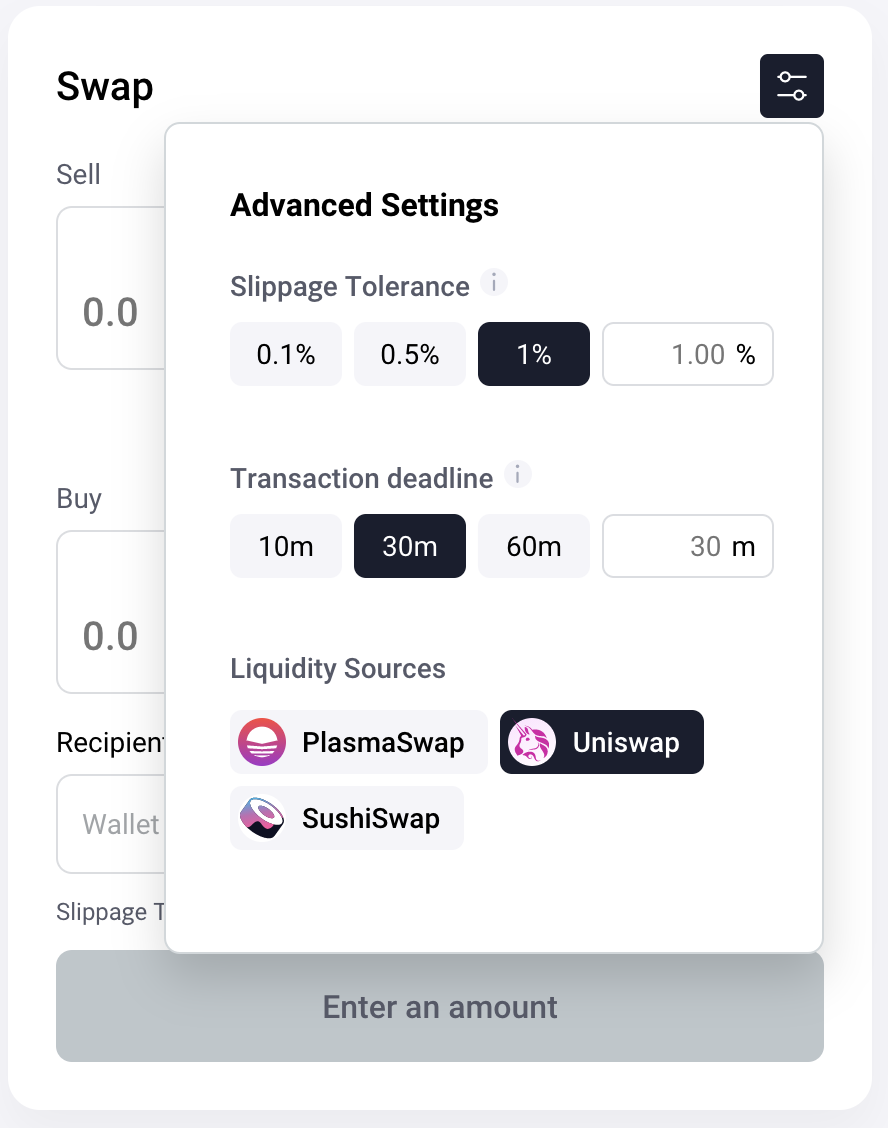
# How to create a liquidity pool for a new token?
To create a liquidity pool for a token pair and list your token on PlasmaSwap, you need to:
* create a pair contract (pool),
* set up an exchange rate, and
* add your initial amount of tokens in the created pool.
1. Visit the Swap page at .
2. Select your token and the pairing token you desire (in this example, we will use ETH and PPAY to create an ETH/PPAY pair). Choose the PlasmaSwap provider in swap settings. If this token pair does not exist, you will see this screen.
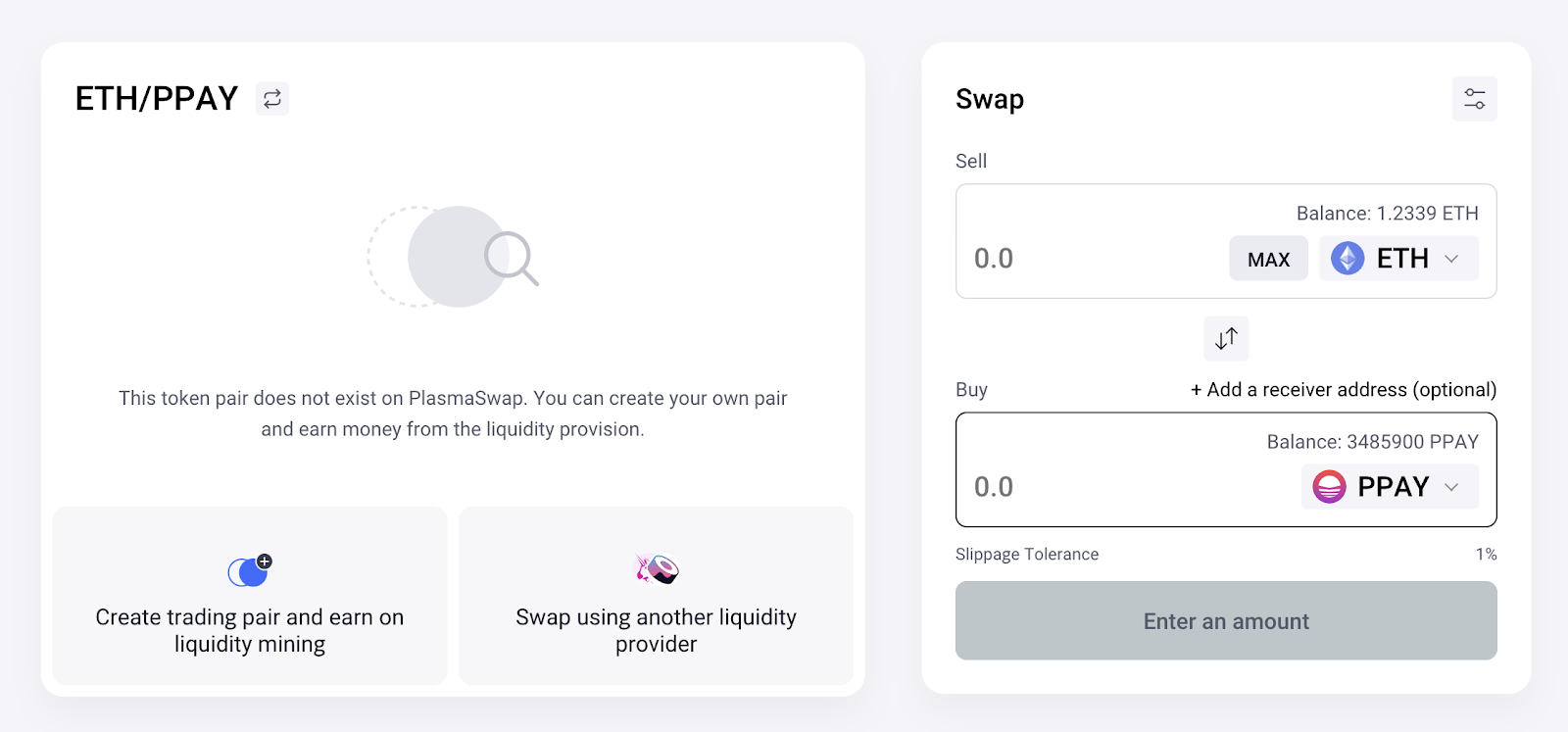
3\. Select the first option, “**Create a trading pair and earn on liquidity mining**”. This will take you to the Liquidity Management page.
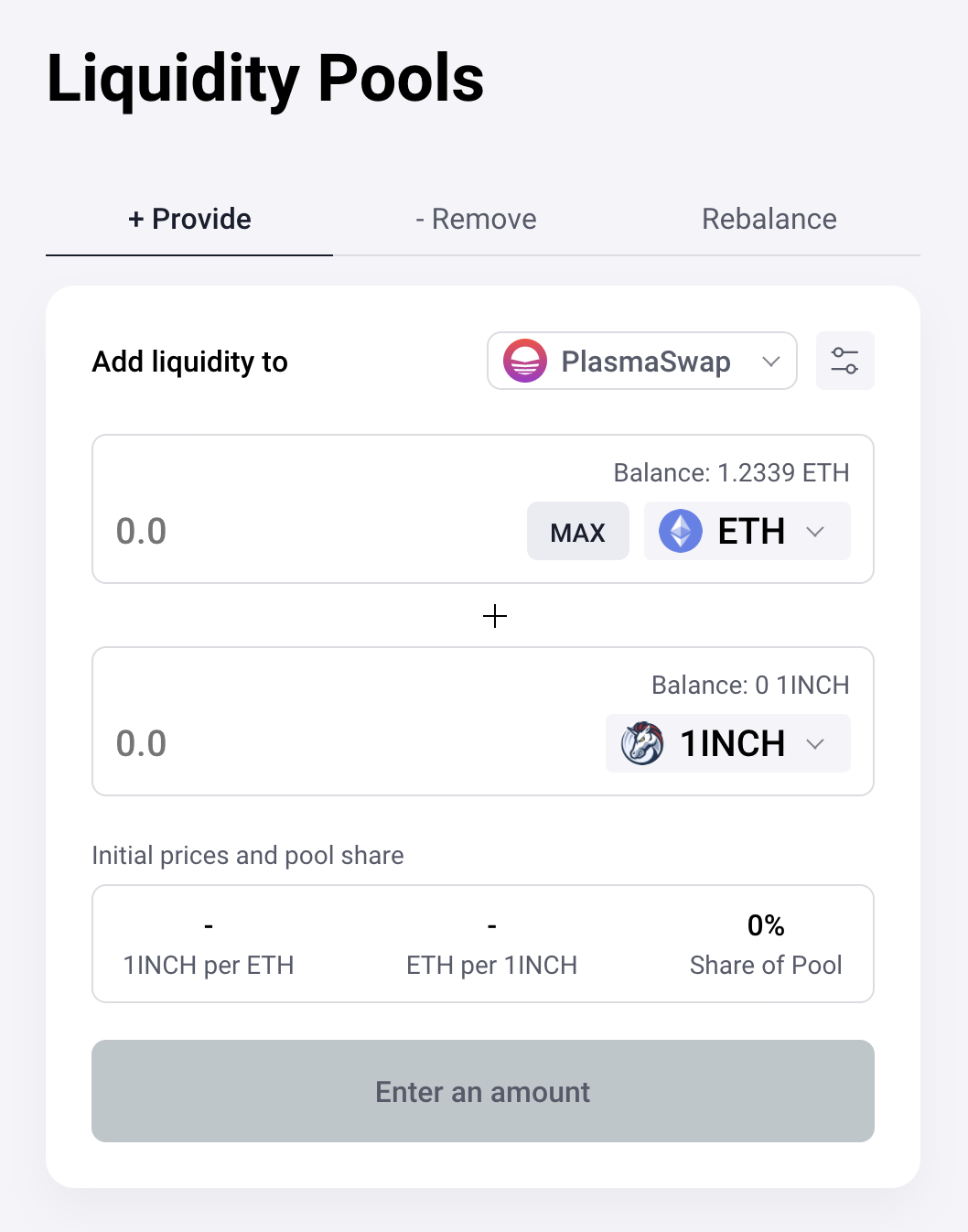
4\. Select both desired tokens. Ensure you also select PlasmaSwap as a provider from the dropdown menu.\
5\. You now need to determine an exchange rate for tokens in the new pool. A good way to do this is to check the rates on another provider like Uniswap and choose the same rate of tokens in this new pool.\
6\. Once you’ve set the initial rates and are happy with them, sign the transactions approval of contracts and supply.
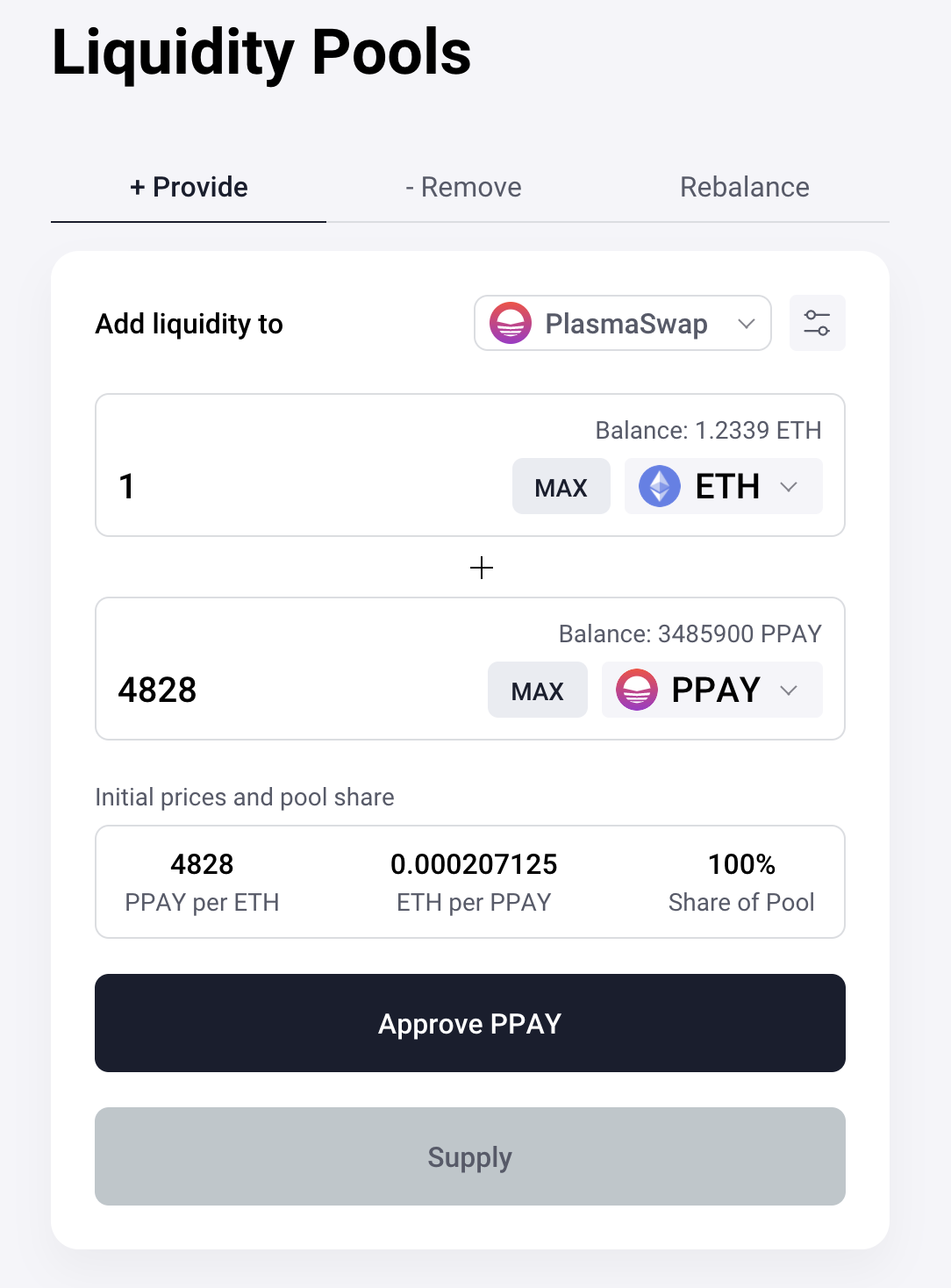
7\. If successful, you will have created a new trading pair for tokens on PlasmaSwap and are also the first liquidity provider to this pair. You should also see the LP tokens representing your share of the trading pool on your wallet balance.\
# How to add liquidity to the pool?
You can become a liquidity provider in any pool and earn returns from trading volume.
1. To provide liquidity, visit the "Liquidity Pool" management page.
2. Choose the liquidity provider from the dropdown menu (PlasmaSwap, SushiSwap, UniSwap).
3. Select the token pair and enter the amount of liquidity you want to provide to the pool. You will need the right balance of both tokens.
4. Sign the transaction to approve both token contracts.
5. When successful, you are supplying liquidity to the pool and will receive LP tokens on your wallet to represent your share of the pool

# How to migrate liquidity (LP tokens) to PlasmaSwap from SushiSwap and Uniswap with Rebalancer Tool
Suppose that you are providing liquidity in the ETH/USDT pair on Uniswap but you identify a better APY on the same ETH/USDT pair on PlasmaSwap.
Thanks to our Rebalancer tool, you can now migrate your LP tokens from one protocol like Uniswap or SushiSwap to another protocol, like to our PlasmaSwap pools -- in a single transaction.
1. To migrate your LPs, please open the "Liquidity Management" page ().
2. Choose your current LP Swap and pair

3\. Enter the amount of LP you want to migrate to the new pool. Make sure that this new pool does exist in PlasmaSwap (if not, just provide initial liquidity to create a pool there first).\
4\. Approve the contract and sign a migration transaction!
**Note**: If the transaction was unsuccessful, please check your Ethereum balance to ensure there is enough Ether to pay gas fees. Also, check the gas fee (GWEI) in your wallet and in Etherscan’s Gas Tracker (). Set up your gas fee in GWEI to be the same as or higher than the highest value indicated by Gas Tracker.
**Note**: If changing your gas price does not help with transaction signing, increase your slippage tolerance % and transaction deadline timing in Rebalancer Settings. If you still have problems completing the transaction, please contact our support team in chat on Plasma.Finance.
# How to switch network in MetaMask on Polygon
You can switch between different blockchain networks while on Polygon quite easily. This guide will show you how to switch between networks on Polygon using the MetaMask wallet.

**Step 1:** Go to

**Step 2:** Connect a wallet you own by entering your password and clicking “Unlock”.

**Step 3:** Approve the Signature Request from Polygon by clicking “Sign”.

**Step 4:** You should now be on the Polygon dashboard. Now, click on the MetaMask extension in your browser and select the Pull Down Menu that says “**Polygon Mainnet**”. A selection will appear, with a tick next to the network you are connected to. Currently, this is Polygon.

**Step 5:** When you need to use Ethereum Mainnet again, just select the “**Ethereum Mainnet**” option to switch to Ethereum. Choosing any other option will connect you to that particular network.

**Step 6:** And you’re done! When you have connected, the wallet should show “Ethereum Mainnet” to confirm that you have just switched to the Ethereum network.
Now you can switch your Metamask wallet between two chains whenever you need it for dapps.
### Option 2.
Go to find a Matic Mainnet and click on "**Add to Metamask**"


### Option 3.
Add Polygon Network in Metamask manually.
1. Open MetaMask and click the network dropdown menu, which is located at the top of the window. This will say “Ethereum Mainnet” by default.

2\. Click “Custom RPC” and enter the details as seen in the screenshot below. We’ve also included a plain text version of the details below the screenshot so you can simply copy and paste.

> **Network Name:** Polygon Mainnet
>
> **New RPC URL:**
>
> **Chain ID:** 137
>
> **Currency Symbol (optional):** MATIC
>
> **Block Explorer URL (optional):**
3\. Click “save”. You’re now connected to the Polygon network!
# How to get a MATIC token to sign cheap transactions on Polygon
You have to have the Matic token on Polygon Chain to sign any transaction and pay a gas fee (GWEI).
Matic (MATIC) is the native asset of the **Polygon chain** using the MRC20 protocol. You can find all the token details at this address “**0x0000000000000000000000000000000000001010**” by looking it up on their official explorer at:

Because Polygon is an Ethereum-compatible blockchain, this means that any token or wallet address you have on Ethereum is also interchangeable with Polygon. You can use the exact same wallet address to interact between your regular ERC20 tokens on Ethereum and with Polygon using the Matic bridge.
This guide shows you how to Swap MATIC from any Ethereum-based DEX like PlasmaSwap using the Matic bridge. You can also do this with any other token, moving it from Ethereum to Polygon in this way.
**Step 0.** First of all you need to get a Matic token on your Ethereum wallet. Please go to [Plasma.Finance Matic Token page,](https://apy.plasma.finance/swap#/market/0x7D1AfA7B718fb893dB30A3aBc0Cfc608AaCfeBB0/trade) connect your wallet (Ethereum Mainnet chain) and swap any token to Matic.

**Step 1:** Go to and choose to connect with your MetaMask with the wallet containing the MATIC Token you would like to migrate from Ethereum to Polygon Chain.

**Step 2:** Choose the MATIC token from dropdown menu, put the amount you want to migrate on Polygon layer and click “Transfer”, than sign transaction with your Metamask wallet. This will send MATIC token from your Ethereum wallet to your Polygon wallet (which has the exact same address).

Please note that you may see several informational popups or disclaimers. Keep clicking “Continue” until you reach the page to confirm the transfer. Select “Continue”.


**Step 3:** Approve the gas fee from MetaMask. Your transaction is now executed and waiting for confirmation! Your Matic is on its way from Ethereum to Polygon! This can take several (7-10) minutes, and you can always check your transaction on by entering either your wallet address or tx ID. It should tell you if it’s Pending or Confirmed.

*After you see the Matic token on your wallet in Polygon Mainnet, than you can sign any on-chain transaction, using your Matic token to pay for Gas Fee.*
Notes: If you'd like to move any asset back to Ethereum Mainnet, you can do the same steps but choose the Polygon Mainnet Network on the Bridge page.
# How to add Plasma $PPAY token from Polygon network to your MetaMask
Polygon Explorer Plasma $PPAY token page: https\://polygonscan.com/token/0x08158a6b5d4018340387d1a302f882e98a8bc5b4
If you see a token in the Polygon network that’s not yet reflected in your MetaMask wallet, don’t worry. Adding it is very simple. In this guide, we will show you how to add the PPAY token from Polygon network into your MetaMask wallet.
**Step 1:** Go to and choose to connect your MetaMask with your wallet, switching the network in Metamask to **Polygon Mainnet**. A step-by-step guide for this is available here:

**Step 2:** In the “Search here” bar, type the name of the token you wish to add to your MetaMask, in this instance, we will type **Plasma**. The token should then come up on the dashboard.

**Step 3:** Simply click the 3 dots on the far right of the line containing PPAY. A popup should appear with the words “**Add to Metamask**”. Select this.

**Step 4:** A MetaMask popup window will appear, confirming that you would like to add PPAY to your MetaMask. Click “**Add Token**”. And now you’re done! When you view your wallet account on MetaMask, it should show you the PPAY asset.

### Option 2.
You can also add Plasma (PPAY) token directly in Metamask. Click on "Add Token" and put the address of Plasma token in the address field.
**Plasma $PPAY official token address**: `0x08158a6b5d4018340387d1a302f882e98a8bc5b4`
**Link to Polygon Explorer Plasma token page**:
# How to move Plasma $PPAY from Ethereum to Polygon and back. Cross-chain bridge
Ethereum PPAY (0x054d64b73d3d8a21af3d764efd76bcaa774f3bb2) <> Polygon PPAY (0x08158a6b5d4018340387d1a302f882e98a8bc5b4)
Moving PPAY between Ethereum and Polygon is possible now via the Matic bridge. Since Polygon is an Ethereum-compatible blockchain, this means that any token or wallet address you have on Ethereum will work on the exact same address on Polygon. So, when moving PPAY, which is an ERC20 token, into Polygon (as an MRC20 token), you only need to use the same address, just switching chains in the Metamask wallet.
This guide shows you how to Move PPAY from Ethereum to Polygon and back using the Matic cross-chain bridge. You can also do this with any other token, moving it from Ethereum to Polygon (and in the opposite direction) in this way.
### Connect Metamask Wallet
**Step 1.** Go to and choose to connect with your MetaMask with the wallet containing the PPAY you would like to transfer on another chain.

**Step 2.** Select the account you want to connect to, then click “Next”.

**Step 3.** You will be asked to allow the bridge to connect. Select “Connect”.

**Step 4.** Sign the request.
### How to move PPAY from Ethereum to Polygon:
**Step 1.** Find and choose the Plasma $PPAY token on the [Polygon Bridge](https://wallet.matic.network/bridge/) screen.

**Step 2.** Input the amount of the Plasma you want to bridge over to Polygon.

**Step 3.** Select “Transfer”. You may be asked to read some informational disclaimers. Just keep selecting “Continue” until you reach the page to confirm the transfer. Select “Continue”.
**Step 4.** Approve the gas fee from MetaMask. Your transaction is now executed and waiting for confirmation! Your PPAY is en route to Polygon!


**Step X**. To move Plasma $PPAY from Polygon to Ethereum back, just do the same steps but on the first one choose a Polygon Mainnet in your Metamask and Bridge from Polygon to Ethereum.

**Note:** Just be aware, instead of ETH for gas fees on Ethereum, you now need MATIC tokens to pay gas on the Polygon network.
**Official Addresses:**
Ethereum PPAY:
Polygon PPAY:
# How to launch IDO (for projects)
Guideline for Token Projects. A Walkthrough for Launching your very own self-made Initial DEX Offering (IDO).
[SpacePort](http://plasma.finance/spaceport) is the democratized open IDO launchpad, for the first time, allowing any blockchain project to quickly set up and launch their own Initial DEX Offering (IDO) on top of the PlasmaSwap DEX.

With SpacePort, powered by [**Plasma.Finance**](https://plasma.finance), we take a step closer to our goal of “**DeFi for the masses**”, giving all projects of any size and stature the same opportunity to access an open, transparent, fairer means of crowdfunding on DeFi.
* No more gatekeepers to tell you how your token setup should be
* No restrictions on project size or type
* No limits to market settings and IDO management
* Fully customizable settings of your choice with our “Contract Factory” tool
Setting up your own IDO is actually really simple, but because this is a new offering and done entirely on-chain, we’ve prepared a handy Walkthrough document here that takes you through the entire process, step by step.
{% embed url="" %}
## Why any project should considering their IDO listing on the Decentralized IDO platform SpacePort
Our Plasma team created a unique platform to organize the most comprehensive IDO using the best practices from decentralized crowdfunding and tokenomic modeling. As a result, all tools and your project IDO are under your complete control and on-chain.
### Benefits of Decentralized SpacePort IDO launchpad:
**Fully decentralized way of web 3.0 crowdfunding** – all IDO contracts are on-chain, transparent and built on trustless infrastructure.
**The most customizable smart contracts for IDO** – you can customize raised currency, soft and hard cap of IDO, dates, limits for investors, whitelist, DEX liquidity lock and rates for IDO and DEX.
**Integrated lockup and vesting contracts for IDO investors** – improve your tokenomic model with zero sell pressure on token launch. Give your investors a convenient UI to track unlocked tokens and claim them.
**Liquidity mining and staking contracts** – launch your incentive program to improve liquidity depth on DEX and provide your investors a comprehensive UI to track ROI on their liquidity.
**Protection from the Rug Pull for IDO investors** – lock your DEX liquidity to give your investors more assurance for their project investments.
**On-chain control of whitelisted wallet addresses** – manage your investor whitelist at any moment directly on-chain.
**Investor analytics** – get full access to the list of investors of your IDO.
**Automatic DEX liquidity pool creation** – protect your project from unexpected liquidity pool opening and let smart contracts manage that task for you. A liquidity pool will be automatically opened for the sold token after its IDO is successfully finished.
**Build-in KYC integration** – the project's team is fully responsible for their investors and any KYC process. Provide a link to your KYC operator to allow for automatic verification of investors before the IDO.
**The full project tokenomic analytics and integrated tools** – upload all your project information (pitch deck, YouYube videos, etc.) and tokenomic information (distribution schedule, allocation model, etc.) to GitHub and make it visible for your investors on SpacePort. Investors will appreciate your full project transparency.
**Multiple use cases of fundraising on Spaceport** – you can use SpacePort launchpad for public IDO or private sales, which makes the fundraising process as solid as possible for you and your investors.
### Token value-added features of Plasma.Finance and Plasma infrastructure:
**Full-informational Token Page** – completely customizable token page with a project and token information.
**Token Portfolio Analytics** – provide your investors full access to the analytics of their token portfolio on one platform.
**Cross-chain PlasmaSwap DEX with limit orders** – our DEX supports on-chain market and limit orders for any pair of tokens.
**Advanced Analytics for DEX and Token** – comprehensive analytics of token ROI, liquidity pools APY and trading activities on DEXs.
**The most user-friendly interfaces in DeFi** – easy to use and understand DeFi interfaces for advanced and beginner users.
**Cross-DEX integration** – Plasma.Finance is directly integrated with the most popular DEXes, like PlasmaSwap, Uniswap, Sushiswap. Users can trade, manage their liquidity and use the analytics across all the DExes.
**Integrated fiat on-ramp** – we support different ways of purchasing DeFi tokens and cryptocurrency with credit cards, bank wires and e-wallets. Available in more than 165 countries.
**Multilanguage DeFi Platform** – platform supports a community-driven localization for 34 languages.
**Live Chat support** – 24/7 live support for users and projects on the platform
## Before You Begin, Here’s What You Need

Setting up an IDO on SpacePort is a completely transparent process following the principles of open and decentralized development that has made blockchain and crypto so successful.
You don’t need anything special to start using SpacePort to launch your IDO! However, we will assume that if you are a blockchain or DeFi project, then you will already have some minimum resources ready. These are anyway what you would need to launch an IDO on any other platform or launchpad:
1. Your completed on-chain ERC-20 token contract on Ethereum Mainnet. If you don't have a token yet, you can create it with a no-code Ethereum tool:
2. Basic knowledge of using and making Github repository commits.
Please prepare the checklist before you create an IDO:
```
Project Data:
- Token Name
- Token Symbol
- Token Contract Address (ERC-20)
- Total Supply
- Short Project Description
- Token Logo URL (256x256px) - file name format: token-contract-address.png
Links (optional):
- Project Website URL
- Telegram URL
- WeChat URL
- Discord URL
- Blog URL
- Twitter URL
- Reddit URL
- GitHub URL
- Etherscan URL
- Whitepaper URL
- KYC Onboarding App URL
- Social Allocation URL
- Youtube Video URL
Charts:
- Token distribution dataset (start date block, period (m or w or d) allocation name, amount unlocked)
- Token allocation dataset (allocation name, amount
Public listing (optional):
- Coinmarketcap ID
- Coingecko ID
IDO Data:
- Token for IDO raise (USDT, ETH, USDC)
- Raised Amount in token
- IDO rate (IDO token / Project token)
- Soft Cap in raised token
- Hard Cap in raised token
- Date of Start IDO (first round for xPPAY)
- Date of Second IDO round (for public, no xPPAY)
Investor Lockup and Vesting:
- Date for token lockup
- Date of token vesting end
PlasmaSwap DEX liquidity:
- Percentage of raised funds that goes to PlasmaSwap DEX liquidity
IDO Owner Wallet with
- Amount for project tokens for IDO
- Additional amount for project tokens for DEX liqudity
- 5 ETH for IDO contract launch
- ETH for DEX liqidity pair open
```
Once you’re ready with a checklist, proceed to the first step.
## Step 1: Provide your Project Token Page information to our GitHub
The first section of this walkthrough deals with your project’s Token Page information. This covers all of the information and details about your token. Entering the right details is important because this will be the first and main source of publicly available information about your project.
You will need to fork and provide us an update (send Pull Request) for feather GitHub repositories:
* (Token Page and IDO information)
* (Token Basic information for DEX TokenList)
Once entered and approved, this becomes part of the Plasma.Finance source code, of which SpacePort is a part. Every single detail you enter will be publicly available in real-time, making your Token Page an on-chain transparent record of your project for the world to see.

1. Log in to your Github account and visit our public repository at .
2. Enter the repository for “[plasma-finance-market-tokenlist](https://github.com/plasmadlt/plasma-finance-market-tokenlist)”. This is where all the decentralized market data for Plasma.Finance and IDO page is stored.
3. From there, select the JSON file to edit at

4\. **FORK it** by clicking on the Fork button at the top right corner, as shown above. When you do this, you’ll be creating a copy of this in your own GitHub account.
5\. **EDIT** Enter your project’s token details following the same format as the others already in there. You can use this as a reference.
```
{
"address": "0x054D64b73d3D8A21Af3D764eFd76bCaA774f3Bb2",
"chainId": 1,
"name": "Plasma Finance",
"description": {
"en": "Plasma.Finance is a cross-chain DeFi aggregator and portfolio management platform.",
"es": "Plasma.Finance is a cross-chain DeFi aggregator and portfolio management platform.",
"fr": "Plasma.Finance is a cross-chain DeFi aggregator and portfolio management platform.",
"hu": "Plasma.Finance is a cross-chain DeFi aggregator and portfolio management platform.",
"id": "Plasma.Finance is a cross-chain DeFi aggregator and portfolio management platform.",
"it": "Plasma.Finance is a cross-chain DeFi aggregator and portfolio management platform.",
"ja": "Plasma.Finance is a cross-chain DeFi aggregator and portfolio management platform.",
"ko": "Plasma.Finance is a cross-chain DeFi aggregator and portfolio management platform.",
"nl": "Plasma.Finance is a cross-chain DeFi aggregator and portfolio management platform.",
"pl": "Plasma.Finance is a cross-chain DeFi aggregator and portfolio management platform.",
"pt": "Plasma.Finance is a cross-chain DeFi aggregator and portfolio management platform.",
"ro": "Plasma.Finance is a cross-chain DeFi aggregator and portfolio management platform.",
"ru": "Plasma.Finance is a cross-chain DeFi aggregator and portfolio management platform.",
"sv": "Plasma.Finance is a cross-chain DeFi aggregator and portfolio management platform.",
"th": "Plasma.Finance is a cross-chain DeFi aggregator and portfolio management platform.",
"tr": "Plasma.Finance is a cross-chain DeFi aggregator and portfolio management platform.",
"vi": "Plasma.Finance is a cross-chain DeFi aggregator and portfolio management platform.",
"zh": "Plasma.Finance is a cross-chain DeFi aggregator and portfolio management platform.",
"zh-tw": "Plasma.Finance is a cross-chain DeFi aggregator and portfolio management platform."
},
"symbol": "PPAY",
"coingeckoId": "plasma-finance",
"coinmarketcapId": "plasma-finance",
"decimals": 18,
"tokenomicsData": {
"totalSupply": "1000000000"
},
"logoURI": "https://raw.githubusercontent.com/plasmadlt/token-list/master/assets/0x054d64b73d3d8a21af3d764efd76bcaa774f3bb2.png",
"tags": [
"defi",
"alliance",
"dex",
"trending",
"ido"
],
"links": [
{
"icon": "website",
"name": "Website",
"url": "https://kovan.etherscan.io/address/0x124Cb827862D666A18f8b0eC11534b0bDd59138D"
},
{
"icon": "whitepaper",
"name": "Whitepaper",
"url": "https://kovan.etherscan.io/address/0x124Cb827862D666A18f8b0eC11534b0bDd59138D"
},
{
"icon": "telegram",
"name": "Telegram",
"url": "https://kovan.etherscan.io/address/0x124Cb827862D666A18f8b0eC11534b0bDd59138D"
},
{
"icon": "reddit",
"name": "Reddit",
"url": "https://kovan.etherscan.io/address/0x124Cb827862D666A18f8b0eC11534b0bDd59138D"
},
{
"icon": "twitter",
"name": "Twitter",
"url": "https://kovan.etherscan.io/address/0x124Cb827862D666A18f8b0eC11534b0bDd59138D"
},
{
"icon": "wechat",
"name": "WeChat",
"url": "https://kovan.etherscan.io/address/0x124Cb827862D666A18f8b0eC11534b0bDd59138D"
},
{
"icon": "discord",
"name": "Discord",
"url": "https://kovan.etherscan.io/address/0x124Cb827862D666A18f8b0eC11534b0bDd59138D"
},
{
"icon": "medium",
"name": "Blog",
"url": "https://kovan.etherscan.io/address/0x124Cb827862D666A18f8b0eC11534b0bDd59138D"
},
{
"icon": "etherscan",
"name": "Etherscan",
"url": "https://kovan.etherscan.io/address/0x124Cb827862D666A18f8b0eC11534b0bDd59138D"
},
{
"icon": "github",
"name": "GitHub",
"url": "https://github.com/ethereum"
}
]
```
Prepare and upload your JSON file for Spaceport IDO page in the folder:
Your folder name: token-contract-address\
Your JSON name in the folder: token-contract-address.json (all low cap)
```
{
"name": "Token name",
"description": "Plasma.Finance is your home for decentralized finance. Invest, Store, and Manage any DeFi token with ease. Plasma.Finance is your home for decentralized finance. Invest, Store, and Manage any DeFi token with ease.", // up to 360 characters //
"descriptionTranslate": {
"en": "Plasma.Finance is a cross-chain DeFi aggregator and portfolio management platform.",
"ru": "Plasma.Finance is a cross-chain DeFi aggregator and portfolio management platform.",
"zh": "Plasma.Finance is a cross-chain DeFi aggregator and portfolio management platform.",
"de": "Plasma.Finance is a cross-chain DeFi aggregator and portfolio management platform.",
"es": "Plasma.Finance is a cross-chain DeFi aggregator and portfolio management platform.",
"fr": "Plasma.Finance is a cross-chain DeFi aggregator and portfolio management platform.",
"it": "Plasma.Finance is a cross-chain DeFi aggregator and portfolio management platform.",
"pl": "Plasma.Finance is a cross-chain DeFi aggregator and portfolio management platform.",
"ro": "Plasma.Finance is a cross-chain DeFi aggregator and portfolio management platform.",
"hu": "Plasma.Finance is a cross-chain DeFi aggregator and portfolio management platform.",
"nl": "Plasma.Finance is a cross-chain DeFi aggregator and portfolio management platform.",
"pt": "Plasma.Finance is a cross-chain DeFi aggregator and portfolio management platform.",
"sv": "Plasma.Finance is a cross-chain DeFi aggregator and portfolio management platform.",
"vi": "Plasma.Finance is a cross-chain DeFi aggregator and portfolio management platform.",
"tr": "Plasma.Finance is a cross-chain DeFi aggregator and portfolio management platform.",
"ja": "Plasma.Finance is a cross-chain DeFi aggregator and portfolio management platform.",
"ko": "Plasma.Finance is a cross-chain DeFi aggregator and portfolio management platform.",
"ar": "Plasma.Finance is a cross-chain DeFi aggregator and portfolio management platform.",
"th": "Plasma.Finance is a cross-chain DeFi aggregator and portfolio management platform.",
"id": "Plasma.Finance is a cross-chain DeFi aggregator and portfolio management platform."
},
"chainId": 1,
"projectVerifiedByAdmins": "0",
"tokenomicsData": {
"totalSupply": "1000000000"
},
"kycUrl": "https://app.plasmapay.com/id/sign-in",
"socialAllocationUrl": "https://app.plasmapay.com/id/sign-in",
"contractAudit": "https://app.plasmapay.com/id/sign-in",
"pitchDeckPdf": "https://app.plasmapay.com/id/sign-in",
"youtubeLink": "https://app.plasmapay.com/id/sign-in",
"tokenomics": {
"startTimestamp": 1623928708,
"period": "w",
"datasets": [
{
"title": "Team",
"line": [0, 0.7, 0.9, 0.8, 1.3, 1.8, 3, 4, 4.3, 5, 7, 8.1, 10]
},
{
"title": "VCs",
"line": [0, 2, 3, 5, 7, 8, 8.5, 9, 10, 13, 14, 16, 18]
},
{
"title": "IDO",
"line": [0, 3, 4, 6, 8, 10, 11, 14, 18, 22, 24, 28, 30]
},
{
"title": "Governance",
"line": [0, 5, 10, 18, 19, 21, 23, 24, 27, 30, 35, 40, 42]
}
]
},
"allocations": {
"datasets": [
{
"title": "Team",
"amount": 10000
},
{
"title": "VCs",
"amount": 18000
},
{
"title": "IDO",
"amount": 30000
},
{
"title": "Governance",
"amount": 42000
}
]
}
}
```
> Tokenomic startTimestamp = UNIX date of the token distribution start. UNIX date converter:
> Period (one option only) : d - day; w - weeks; m - month
> Line: number of unlocked tokens based on the chosen period schedule for each allocation. Better prepare these numbers in excel first, and then copy data to JSON, using the comma between numbers.
> projectVerifiedByAdmins - always set to 0
You also can upload to your Spaceport folder Whitepaper.pdf and Pitch-deck.pdf
6\. When entering your **logoURL** details, first upload your logo to the “assets” folder, as shown above. The token logo should be uploaded to using format token-contract-address.png (all low cap)
7\. After completing asset uploads and code edits, **PUSH** the commits back to us (make a Pull Request). Our developers will then examine your commit for coding compliance and approve it as an Update in the next 24 hours.
8\. Repeat Steps 1 to 7 for this JSON file: to ensure all your Token details are also updated on our PlasmaSwap DEX TokenList itself.
[TokenList](https://github.com/plasmadlt/plasma-finance-token-list/blob/master/plasma-finance-token-list.json) Scheme Format:
```
{
"address": "0x054D64b73d3D8A21Af3D764eFd76bCaA774f3Bb2",
"chainId": 1,
"name": "Plasma Finance",
"symbol": "PPAY",
"tags": [
"defi",
"alliance",
"dex"
],
"decimals": 18,
"logoURI": "https://raw.githubusercontent.com/plasmadlt/token-list/master/assets/0x054d64b73d3d8a21af3d764efd76bcaa774f3bb2.png"
},
```
{% hint style="info" %}
Make sure that you are using a CheckSum address of your token address in all JSON files. You can check your address Checksum format using this link: (toChecksumAddress)
{% endhint %}
## Step 2: Supply your IDO Page details
The second section of this walkthrough deals with your project’s IDO Page information. It covers all of the information and details about your current IDO. Entering the right details is important because this will be transparently displayed to anyone viewing IDOs on SpacePort or PlasmaFinance.
Unlike centralized IDO lists, or even market databases, you have to rely on centralized sources to manually enter information and this can take days. With SpacePort, as soon as your commits are approved, all data is updated in real-time from on-chain sources. In fact, any other investor can use Github in the same way to update details like Circulating supply, etc. and as soon as the commits are approved, the data is updated in real-time.
In this way, investors can view your project details, tokenomics, allocations and all kinds of IDO analytics, to help them choose the best projects suitable for their investment needs. They can even trade the token on PlasmaSwap DEX directly, once the IDO completes successfully, all from the same page.
{% hint style="info" %}
**NOTE**: Before you proceed with Step 2, we should mention that you should first prepare before-hand much of the information and details. For example, the common ways to specify pricing, and best practices for tokenomic models, and so on. You can find some of this information in our blog post: How to Prepare for an IDO.
{% endhint %}


1. You will also be asked to enter in JSON three particularly important details here:
* Whether or not your IDO will have a social allocation for influencers or so, provide a link to your form/page in JSON file ("socialAllocationUrl").
* Whether or not your IDO will implement KYC. Here, you can choose your own KYC provider and provide a link to the Github token JSON file ("kycUrl").
* Security Audit of your contract. Provide in JSON ("contractAudit") a link to the public audit report.
## Step 3: Notify us of your Commits (Pull Request)
In total, you should have entered commits for 3 items:
1. Market Token List (for decentralized Market data)
2. Token List (for PlasmaSwap DEX data)
3. IDO Page (for IDO data)
To ensure we are notified and aware of new commits, please send our developers an email informing them of your commits (PR) at .\
\
Note: The entire approval and Update process can take up to few days.
## Step 4: Launch Your IDO
Once you’ve entered all the necessary setup information (Steps 1 through to 3) and we’ve approved all your commits as Updates, you’re ready to launch your IDO!
Other than the on-chain ERC-20 token contract, we also recommend that you have, as an option, a security audit for that contract. This would go a long way to convince potential investors that your contract has been audited for security and is free from common exploits and rug pull backdoors.
Before we continue, there are a few important things to note about the way SpacePort IDOs function, since they are designed to promote safer, more transparent democratic crowdfunding. As a result of these functions, there are important considerations for your project:
1. **Do NOT launch an IDO raising funds in the same asset pair as an existing Liquidity Pool on PlasmaSwap. Do NOT open a Liquidity Pool for the IDO pair on your own.**
2. **A successfully completed IDO (defined as funding that has at least reached a soft cap target) will automatically open a Liquidity Pool on PlasmaSwap with both the token sold and the type of asset raised. For instance, if raising in ETH, then the Liquidity Pool opened will be in the TOKEN/ETH pair.**
This means you should NOT have an existing Liquidity Pool of the same pair before launching an IDO. Should you launch an IDO raising funds in the same asset as an existing Liquidity Pool on [PlasmaSwap](https://apy.plasma.finance/swap), SpacePort will automatically mark the IDO as unsuccessful or scam.
This is to prevent projects from deliberately defrauding investors for tokens with existing liquidity on [PlasmaSwap](https://apy.plasma.finance/swap) and to prevent potential frontrunning by opening secret pools to buy tokens and later dump on investors. To avoid this, simply set up your IDO to raise funds in an asset pair not already opened on PlasmaSwap.
#### To begin your IDO customization, go to "**IDO Lab" page** and click on "Launch IDO"
Enter the details required on the forms you see, as shown by the images above. Please ensure you triple-check all of this information as you will not be able to change them once you launch the contract. Every field will have an explanatory text next to it to help guide you through them.

For DEX Listing Rate, what you specify is the starting rate on PlasmaSwap. Here, you will also specify the amount of raised assets from the IDO that will be used to form the Liquidity Pool on PlasmaSwap if the IDO is successfully closed.

**Note**, an amount of your token equal to the value you specify will also be locked into the Liquidity Pool of PlasmaSwap DEX. So if you raise in DAI and set the 100% of raised funds to go to DEX liquidity, for example, and $10,000 worth of DAI is locked, then $10,000 worth of your token is also locked into the Liquidity Pool.

For Lock Up and Vesting, you can specify various periods to ensure liquidity is locked, how long investor tokens are locked, set limits per user and even an IDO Whitelist (we’ll get to that later).

When you are done, you can check all the details as you have entered. When you are satisfied, scroll down, and select APPROVE to authorize the contract. When this is done, it should have an APPROVED message and tick, as shown in the image above. All you need to do now is click the “Create IDO” button and you will execute the contract launching your IDO! Congrats 🚀

Once launched, anyone visiting the IDO page should be able to view your active IDO, which will display in real-time all the necessary information, as shown in the image above. This includes the start and finish date, sale details, allocation, and even the milestone details like Soft and Hard Caps, and progress towards that.
{% hint style="info" %}
After you create your IDO (deploy contract), you can still change the dates of IDO start and second round, a whitelist of investors in your IDO Lab. All other numbers will be set in stone.
{% endhint %}
## Managing Your IDO
Although you won’t be able to change most specifications or settings of your IDO once launched, you are still able to perform some actions. To do this, simply visit the Manage IDO settings page.

From here, you can:
* Update JSON on Github - (Steps 1 through to 3)
* Manage your Investors Whitelist
* Change the Dates of IDO (start and second round)
* Manage the Max investment per person
* Manage the investor list after IDO
* Claim raised funds
* Launch a DEX Liquidity pool


## Managing Your Investor Whitelist

From the Manage Your IDO settings, you can specify participants for your IDO. Simply enter the addresses you wish to whitelist or upload a CSV file containing the list, and click SUBMIT. Each list submission or update will request an interaction with IDO smart contract and will cost you Gas Fees.
You can also download this whitelist from this screen as a CSV file.
## Succesful IDO
After successfully finished IDO you will be able to claim funds and launch a DEX liquidity pool for your token on PlasmaSwap.
**Note:** Due to the decentralized model of SpacePort, ANY IDO investor will be able to launch a liquidity pool with your token on the DEX once your IDO is successfully completed.

## Unsuccessful IDO
If the IDO is unsuccessful (Soft Cap is not met during the IDO timeline or Someone opens a token liquidity pool on DEX before IDO is finished), you will be able to claim your tokens back. All investors will be able to claim their invested funds.

## Unsold IDO Tokens
If the Hard Cap is not met, all unsold IDO tokens will be transferred to the xPPAY Governance contract. xPPAY Governance will need to decide on what happens with these unsold tokens -- they will either be burned or held on the governance address.
## KYC Provider for IDO whitelist
Thanks to the decentralized model of SpacePort IDO launchpad, each project can set a custom KYC provider for their IDO or opt to run an IDO without KYC.
Please add to your Spaceport project JSON ("kycUrl") a URL link to set your KYC provider for the public investor.
After you collect all data and wallets from your potential investors, you will need to upload all whitelist's addresses to your IDO Whitelist, using IDO Management Page. Please validate all the wallet addresses before you upload them to IDO contract. For bulk ETH wallet address validation, paste your list of addresses in the check field of this services: or
For KYC provider, we recommend:
* [https://sumsub.com](https://sumsub.com/)
* [https://blockpass.org](https://blockpass.org/)
* [https://protocol.fractal.id](https://protocol.fractal.id/)
* [https://synaps.io]()
* [https://onfido.com](https://onfido.com/)
## Spaceport IDO platform fees
SpacePort is managed by xPPAY Governance. Governance can set different fees for the platform using a community voting mechanism.
The current SpacePort fees set by xPPAY Governance is as follows:
* **Fee from raised funds** - 5% \[goes to xPPAY staking contract to incentivize IDO investors]
* **Fee in IDO project tokens** - 5% \[goes to SpacePort Launchpad Index fund managed by xPPAY governance]
* **IDO contract creation fee** - 5 ETH \[goes to SpacePort operating team to support future development and platform maintenance]
* **PlasmaSwap Liquidity Pool creation fee** - 1% from locked liquidity \[goes to xPPAY Governance]

**Note:** The SpacePort fee structure may be modified by xPPAY Governance in the future. You can always find the current fee structure in the [Spaceport Settings Contract.](https://etherscan.io/address/0x90De443BDC372f9aA944cF18fb6c82980807Cb0a#readContract)
## Liquidity Mining and Staking for your project on Plasma.Finance
Each project can launch its own liquidity mining contract for DEX liquidity pair on PlasmaSwap or Staking contract, which will be listed under Plasma.Finance Saving Page and available for all users with UI and analytics. To create an incentivization program on Plasma.Finance platform, please customize and deploy the relevant contracts from our GitHub [**Plasma Staking Factory**](https://github.com/plasmadlt/staking-factory) and contact our support () to list them on the platform.

## Other Features to Note
1. IDO Templates - you can copy existing templates simply by forking the existing repositories on Github to retain their settings and then adjust them to suit your needs. This is a quick way to set things up from the basics.
2. SpacePort IDOs are exclusive on PlasmaSwap - you can, of course, open pools on other protocols like Uniswap or SushiSwap before or after your IDO.
3. Support and questions - we will be building an FAQ once we collect the most common questions and answers. You can, of course, contact us on our normal Telegram groups for SpacePort at
## Technical information
The latest SpacePort and PlasmaSwap smart contracts that have been deployed, audited and verified
```
"Spaceport_ETH_Mainnet": {
"SpaceportHelper":"0x7d196473189bf14F50eD5e9221faE11EBee80BE8",
"SpaceportGeneratorv1":"0x5492EefC9330a7cFf4EF9519A893681CD109040A",
"SpaceportLockForwarder":"0x5AD2A6181B1bc6aCAbd7bad268102d68DE54A4eE",
"SpaceportFactory":"0x67019Edf7E115d17086e1660b577CAdccc57dFf3",
"SpaceportSettings":"0x90De443BDC372f9aA944cF18fb6c82980807Cb0a",
"PlasmaswapLocker":"0x0e0A514E6dB0194978920Cb86a2b40a264b9a283",
}
"PlasmaSwap_ETH_Mainnet": {
"PlasmaswapFactory":"0xd87Ad19db2c4cCbf897106dE034D52e3DD90ea60",
"PlasmaswapRouter":"0x5ec243F1F7ECFC137e98365C30c9A28691d86132",
"LimitOrders":"0xb586990FDeD9B7d57c0a1D1f121e0C214501cECc",
}
```
## Test your token and IDO with Spaceport on Kovan Testnet
If you'd like to test all the processes of IDO creation and even record a walk-through video for your potential investors, you can connect your wallet to plasma.finance platform and switch network in Metamask to Kovan Testnet. You will be able to create your test IDO with your token on the Kovan network (you need to deploy your token smart contract in Kovan Testnet before the tests).
## Unique IDO Use Cases
SpacePort allows any project, big or small, to access a fair and democratic means of blockchain-based crowdfunding. For the investor, it also presents the most transparent way for you to view potential IDOs and participate in them. Unlike most IDO platforms, you can see every single detail about the IDO transparently displayed with real-time accuracy thanks to on-chain data sources.
Because of the unique, customizable characteristics of SpacePort, projects can also make use of them in at least two types of token sale use cases:
#### An easy, secure platform to host private sale rounds
No need to host complicate private sales any longer, holding manual escrows and individual token distributions prone to mistakes. Instead, use SpacePort to build your own customized private sale rounds:
* Vesting and lockup periods are built into smart contracts and automatically enforced. No more private sale investors are going rogue and selling against their side contracts.
* Claiming UI that lets you close your private sale any time you want, claiming your funds raised and releasing tokens to investors as per contract.
* Manage your whitelist directly from the IDO management panel, specifying who can take part in your private or seed stages.
#### Open DEX pools for multiple funding rounds
* Open multiple stages simultaneously, each with a different asset raised. Whitelist one for a private list of clients, make public another for general participants, have different conditions for each, as you wish.
* Finalize stages at will. You can close any IDO when reaching at least Soft Cap, to immediately open a pool on PlasmaSwap and claim the raised funds.
We hope you enjoy the freedom and open access for IDOs on SpacePort, you won’t find anything that comes close to it in the current market in terms of features, customization and built-in transparency! With [SpacePort](http://plasma.finance/spaceport), we hope to improve the way projects raise capital for a safer, fairer, more sustainable DeFi ecosystem.
We wish you and your project all the best. We are ready to come and support you at any moment. Please don't hesitate to contact us via telegram [SpacePort Community Chat](https://t.me/spaceport_chat) or email:
**To apply for our full-circle incubation program, please complete the form** [**here**](https://plasma.typeform.com/to/K3mFrkza)**.**
Best regards,\
Your SpacePort Team 🚀

# How to participate in IDO (for users)
Guideline on how to participate in the Initial DEX Offering Event on Spaceport
Now that SpacePort is live, you will be able to participate in IDOs as they launch!
To help you understand how to do this, we’ve prepared a video walkthrough for you, which you can watch here:
### The steps are quite easy:
1. Open [SpacePort](https://apy.plasma.finance/#/spaceport) or visit the [Innovation Hub](https://apy.plasma.finance/#/innovation-hub) page and connect your wallet
2. Any upcoming or ongoing IDOs will be listed there.
3. You can click on the Token Page of an IDO you’re interested in to review all the project information as they are available. Website links, whitepaper, tokenomic, social media links are all available here.
4. Scroll down and you will see the IDO status. A countdown will show if it hasn’t started yet. If it’s LIVE, you should see the start and end block of the IDO.
5. You will also see the IDO ticket price in xPPAY. This is the amount of xPPAY you need to be able to participate in the IDO first round. This is simply a minimum requirement, it does not lock or use up your xPPAY.
6. Check the IDO stages tab and look for a whitelist, if there is one. You’ll need to apply for it there.
7. Once you’ve been whitelisted, simply go to the LIVE IDO and look for the “Invest” section. You can enter the amount you would like to invest or use the scroll bar to do this. The output in the IDO token will adjust to show you how many tokens you are buying.
8. Click “Buy” and sign the transaction. When confirmed, the tokens are sold and you’ve just completed your first IDO participation!
### Video Guideline
{% embed url="" %}
### How to get xPPAY
To get **xPPAY** you need to buy **PPAY** and [stake](https://apy.plasma.finance/#/savings/manage/0x9Fd1d329BB687fef164F529f6F6DcD6f69e7b978) it, or just buy xPPAY on PlasmaSwap DEX.
1. PPAY is the native token of PlasmaFinance. You can buy it directly from PlasmaFinance using the [PlasmaSwap DEX](https://apy.plasma.finance/market#/swap) (search for PPAY) or buy it from [Bittrex Global](https://global.bittrex.com/home/markets) (available to buy in USD, USDT and BTC). All exchanges where PPAY is available you can find on [Coinmarketcap](https://coinmarketcap.com/currencies/plasma-finance/) or [Coingecko](https://www.coingecko.com/en/coins/plasma-finance) page of Plasma.Finance
2. xPPAY is the derivative token of PPAY, received automatically when you stake PPAY in the PPAY Savings pool: .\
You will be able to see the rate of exchange when you access the Staking page. Alternatively, you can buy xPPAY on PlasmaSwap DEX.
### What next
1. When the IDO is completed, a liquidity pool is automatically launched on PlasmaSwap DEX in the same token pair you bought the tokens for. Anyone can also open a trading pool on the DEX after this, using at least 30% of the raised asset. You can, of course, trade this token across any DEX from Plasma.Finance
2. The tokens you buy may be locked and vested for a certain period, and you can always claim unlocked tokens at any time as they become available from the IDO Page or Portfolio.
### IDO rounds
Each IDO on SpacePort has 2 rounds:
1. The first round is for **xPPAY holders only**. Model of the 1st round: First-come, First-served (FCFS). This round has a duration of only **15 minutes** and available only for investors who hold at least 20,000 xPPAY.
2. The second round is for **everyone**. Model of the 2nd round: First-come, First-served (FCFS). This round's duration is set by the project and can be from 5 minutes until 1 month. Anyone can participate in this round.
If the project has KYC (investor verification system), you need to apply for that before IDO to have the ability to participate in it.
### Integrated fiat-on ramp
If you don't have enough ETH or another token to invest in IDO, you can always purchase it using a credit card or bank wire, using our fiat-on ramp system on the [Market Page](https://apy.plasma.finance/#/market?tag=cryptocurrency).
### Fake tokens and scam IDO
Anyone can freely create a token and initiate an IDO for it (including fake versions of existing tokens). It is also possible for token developers to mint near-infinite tokens and dump them in the market. Potential investors in IDO must conduct their own due diligence of any issuer, cryptocurrency, token or token-based security. Investing in cryptocurrencies, tokens and token-based securities is highly risky and may lead to a total loss of investment.
If you have proof or information that one of the IDO on Spaceport is a scam/fake, please contact our support () to check and block it.
# About HyperDEX Widget
Trade any tokens on HyperDEX aggregator without leaving your app or website and get referral fees.
With the HyperDEX swap widget, your users can trade any tokens on the HyperDEX aggregator and check their wallet portfolio without leaving your app or website!
HyperDEX is a DEX aggregator with access to $100B of liquidity on 6 chains.

### Live version of HyperDEX Widget:
{% embed url="" %}
### Example use cases for HyperDEX Widget:
* Swapping assets in the DeFi application on multiple chains
* Bridge assets between EVM-chains
* Check the portfolio and balances of the wallet
### Major benefits of HyperDEX Widget:
* No-code integration and setup (build-in RPC and Wallet Connect)
* Integrated fee-sharing feature (share swap fees with a referral wallet of website or app)
* Global token list (more than 10,000 assets)
* Multi-chain support: Ethereum, Polygon, BNB chain, Avalanche, Fantom, Celo
* Aggregated liquidity from 70+ DEXes on 6 chains
* Supporting any size of trade: from 1$ to $500M
* Widget customization (referral wallet, color scheme, assets, chains)
* Customizing the Default Input and Output Tokens
* Multi-chain Portfolio Manager
* Suppor of the major wallet providers (Metamask, Trust Wallet, Coinbase, Wallet Connect)
* Responsive Widget Design
* Secure integration
* More features on request
### HyperDEX Widget UI
#### Swap Section
Swap Any token on the DEX aggregator HyperDEX

#### Bridge Section (by request)
Transfer your tokens between chains using s bridge aggregator

#### Portfolio Section
Check your portfolio and asset value on multiple chains

Interesting? Here is the [setup guide for the widget >](/hyperdex-widget/hyperdex-widget-integration)
Have questions? Contact us:
# HyperDEX Widget Integration
No-code integration of DEX widget
### HypeDEX widget code for iframe integration
Copy paste the widget code to your website \ or app.
```
```
### HyperDEX widget code for Button integration
Copy paste the widget code to your website \ or app.
With Button "Swap":
```
```
### Widget Customization and Fee setup
Optional parameters of the DEX widget
`r= string` - referral address for fees from each Swap
`chainId= string` - Network Id (Ethereum: **1**; Polygon: **137**; BNB chain: **56**; Avalanche: **43114**; Fantom: **250**; Celo: **42220**; Optimism: **10** )
`fromTokenId= string` - Token Contract Address
`toTokenId= string` - Token Contract Address
`darkTheme= boolean` - theme mode (1 - dark mode, 0 - light mode)
`closeBtn= boolean` - close button for iframe (1 - yes, 0 - no, modal window)
To call the Tab just use its name (Swap, Bridge, Portfolio) in the URL ([https://widget.plasma.finance/bridge](https://widget.plasma.finance/bridge?darkTheme=1))
Example of parameters in the src link:
```
// Example 1
https://widget.plasma.finance/?closeBtn=1&darkTheme=1
// Example 2
https://widget.plasma.finance/?chainId=56&toTokenId=0x8AC76a51cc950d9822D68b83fE1Ad97B32Cd580d&fromTokenId=0xfb288d60D3b66F9c3e231a9a39Ed3f158a4269aA
// Example 3
https://widget.plasma.finance/?chainId=56&r=0xba579c9b6a7b178edbcdc158b8eae260491871c8
```
### Widget Integration Example
Iframe \
SWAP button